Staying Human as AI Takes Over the Transactions | Eve Vanderpool
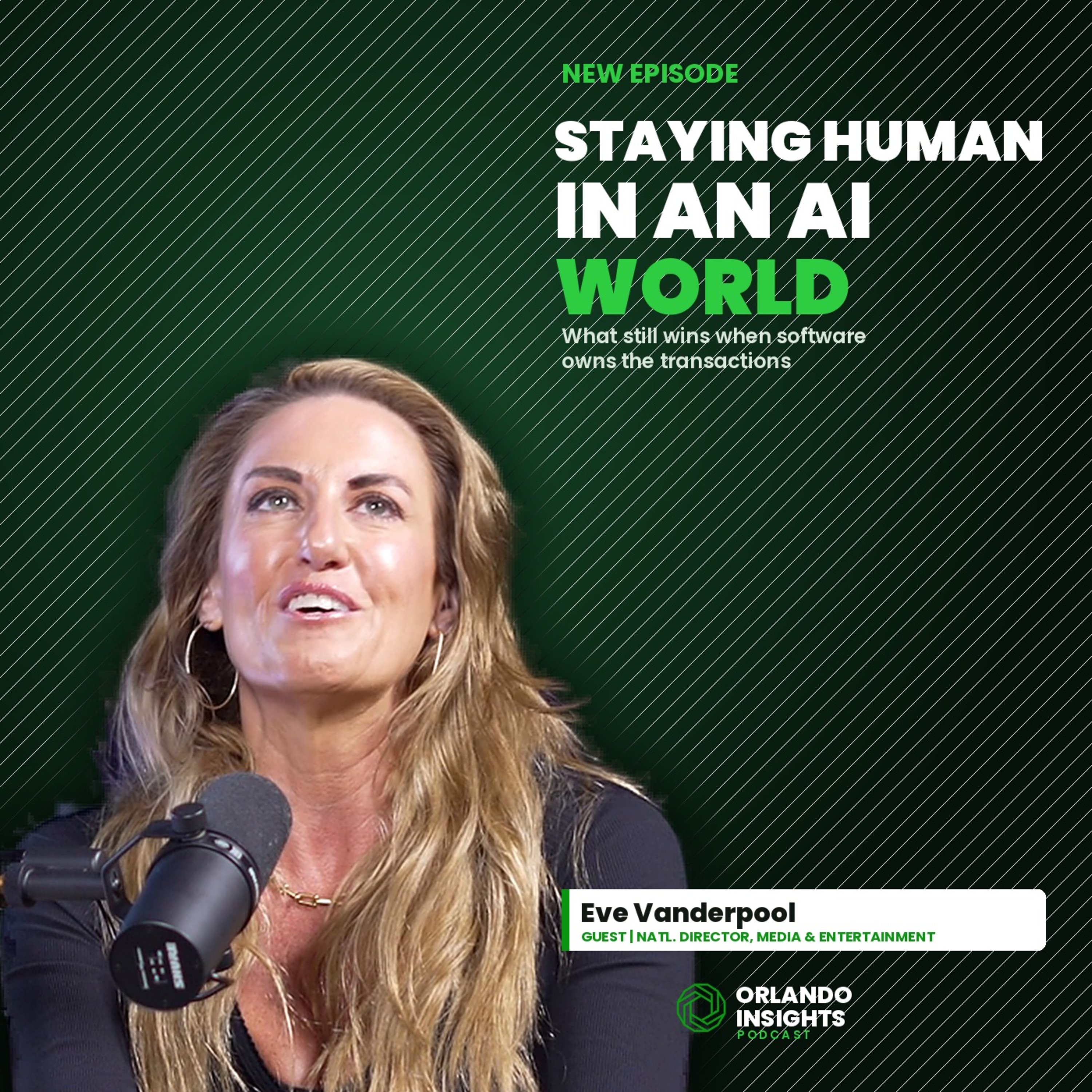
AI already has the transactions and the logic covered. Eve Vanderpool argues that makes the human part of business more valuable than ever.
On this Orlando Insights Podcast episode — our first recorded in a real studio, and our first in Florida — Eve Vanderpool, National Director of Media & Entertainment at KellyMitchell Group, talks reinvention, staying human as AI takes over the transactions, and why leaders should make room for people to try new things.
In this conversation:
- Why uniqueness, authenticity, and showing up as yourself still win when software owns the transactions
- The small human acts AI cannot replace — handwritten notes, personal recommendations, showing up for clients
- Why leaders should create room for mistakes and new ideas, not only the perfect answer
- How Eve's father's escape from communist Czechoslovakia after Prague Spring still shapes how she meets hard problems
- "You were hired for a reason. You are enough." Stay curious and bring your whole self
Guest: Eve Vanderpool, National Director of Media & Entertainment, KellyMitchell Group
Host: Henry Clavo, Founder & CEO, Orlando Insight Group
Recorded at Secret Office Studios, Orlando, Florida
Release: Friday, November 13, 2026, 5:00 AM PT
Subscribe for more conversations with technology and business leaders.
#OrlandoInsightsPodcast #AI #Leadership #Reinvention #KellyMitchell
Transcribed automatically by PodView
People like to do business with people that they like. That's a fundamental that's not going to change. Those little things that a robot can't do, they can't handwrite a note. They can't bring you the best donuts from all the way across town. I can't. So, hi, I'm your host, Henry Clavo, CEO and founder of Orlando Insect Group. Each episode, we dive into real conversations with technology leaders, innovators, and experts, influencers who shape the future IT, data, and cybersecurity. And our goal is simple, to give you practical insights, real-world strategies, and expert perspective that can use to drive smarter decisions and strong results for your business.
So today's episode is a special one. We're here in Orlando, Florida. And we have here Eve Vanderpool. Come back again. I want to touch upon a topic. I made a mistake regarding your background. own. So now we could clear for the record. Well, thank you for having me. Yeah, I am in staffing and solutions for technology, not as a recruiter, but as for sales, but minor discrepancy, but our roles are very different. But we'll talk more about where that's going in a bit. Yeah, definitely. And thank you for meeting with us today.
So we'll be discussing reinvention. So, Eve, at the end of your first conversation, you said that you were finally bringing your skills and life experience together. Do you feel any closer to understanding where they are taking you? Yes. after many, many conversations from maybe like late spring over the summer. I had a few conversations with former leaders, current leaders of my former place of employment and continued to have conversations about what I wanted to do, where I wanted to go, how the landscape was changing and technology.
And I got a lot of great input. a lot of similar advice from different people who had not spoken to each other. So I felt because of that, that information was tracking for me. So ended up working out that I had a former leader and two current leaders of my most recent employment recommend me to the same person for a role that had not yet been created. And when they asked me what I wanted to do, I said the same thing that I talked to you about last time. And I said, I really want to bring together my love of technology, digital marketing, you know, business acumen and technology, obviously.
And bring that together in a sales role where I can help build out a team, build out process and really help guide people. And, and I love that relationship piece. So I was allowed to kind of create my own role, if you will. And we over the really happened very quickly, especially since I was recommended by a former leader. And then that leader in my new place of employment, which is Kelly Mitchell group, they said, you know, we talked to a few other people that you'd worked with, and they all said the same thing about you, and that we needed to meet with you.
And so within a week, I had like maybe nine interviews. They flew me out to Dallas. And again, everyone's like, what do you want to do? And I was discussing with them, you know, my vision and where they were at and what, you know, kind of help I could bring them in building out their teams. And we all agreed that it was a really great match. So it happened very quickly. I guess when you know, you know, there's a decisiveness to it. And I am able to do that. So I am starting this coming Tuesday. Well, by the time this airs, I'll already be a few weeks deep in.
So that might be a follow up. But I'm really happy for the opportunity to have talked to so many people like yourself and just kind of expressed, you know, what it is that I'm looking for when I think the direction of technology is going in. Definitely, definitely. So with this new role and responsibilities, will you have a team under you or that's still to be decided? I will have a team under me. A lot of that is contingent on how we, the company and I, decide to kind of build that out. And in what areas will those teams be focused, right?
So initially there's going to be a lot of strategizing, preparing, setting up the structure for those teams to come in and be set up for success. And will it be in the Orlando area or will it be throughout the country? Throughout the country. Throughout the country, okay. Yeah, it is a fully remote role, as are most of the roles within this company. But that's just because there's so many clients around the country. It just doesn't make sense to go into an office regularly. Yeah, since the change in the pandemic, everything has been remote.
So do you foresee that coming back or it's more efficiency now here on after? Probably depends on the company and the team. If you're located within the field, maybe it makes more sense to be in the city and area in which you operate. I'm on a national enterprise level, so it makes sense for me to not always be traveling when I don't have to be because there will be enough travel that comes along with that. But I do think for sometimes younger people or newer people in a role, it is very helpful to be in person, to be able to connect, collaborate, and follow up.
But for me, for myself, this is a better path and just better for this time in my life. Definitely. You'll have time when company events or, let's say, conferences come later in the year. Exactly. Tons of conferences, tons of events. And that's the fun part, right? When we first met through the podcast inbox and we did our first episode, what did episode one leave and finish for you? Like, what was something that you wanted to discuss that we couldn't do in the first episode now that we're here?
Yeah, you know, probably, and we touched upon this like a couple times, but we didn't really kind of go into the importance of bringing our whole selves to work. And I mean by our whole selves, the people that we are, our interests outside of work. What we're like once that three month to six month mask slips of people being that perfect employee, you know, which obviously doesn't exist. So who are you when you come to the office and how does that shape how your operational work? How does that shape how you behave at work, who you interact with, how collaborative you are, how you take the initiative, how much you can kind of weed through the everyday red tape to get to the solution?
So I think that is something that I love to talk about because there's not too much of a mask with me. You know, it's I try to put a filter up, just as not to offend someone right off the bat. But it doesn't really last for long. So I think to me, I've been more self-aware of how I really operate and how, you know, my background and what that brings to work than maybe other people who can keep up the trade for a while. Yeah. So to me, that's always been important. And I think that it really transcends our activities, our everyday, what we do when no one's watching.
That transcends how we behave in the workplace. Yeah, that takes time. And you know these people, how they work. Once you get to know them and work in this environment, this is the ultimate test of their character and what they bring to the table. Right. And, yeah, you will do great. so congratulations Eve thank you you told us you were writing again and quietly developing a substack so what are you ready to reveal about that project so the substack has gone by the wayside because I've gone to just writing in basically just Apple Notes and I'm writing a little bit each day some of it is going towards the ultimate project where I'm talking about my father's immigration to this country which is just a timely conversation and personal, obviously, to me.
So I'm writing a little bit about that. But when I get blocked up, I still make it a point to carve out that space each day and just write about something, even if it has nothing to do with anything. And it's just, you know, musing about some topic that I saw, you know, online or just, you know, even having a writer's block. So I'm still carving out that time, about 15, 20 minutes each day. Sometimes I get on a roll and it goes into an hour and I look up and it's been a long time. But I'm at least carving out 15 minutes to really chip away at it.
So it's been going well. I keep going back through processes and iterations of what I want to say I like okay this matters to me but why would someone else care about this Does this give context to the story Because as a culture I feel like we so low context Like we come up and just say, hi, my name is, I do X, Y, Z. I live here. And that's really low context. And I feel like as a storyteller, the more high context you are, Yeah. The more people care about why your story matters to them. So I'm working on that.
It's a cultural shift for me, though. I'm curious. You mentioned your father and immigration. It's a really big topic right now, especially. Maybe you could go a little, talk a little bit about your father and when he came to his country and why you decided to write a specific piece about him. Sure. So he came from what was at the time Czechoslovakia, a communist nation. And he escaped right after Prague Spring during the 68-69 amnesty, amnesty granted by the United States government. Whereas if you could get to America, you could stay under political asylum.
And there was a path for citizenship for you. so without you know going too deep into it there was a point in which he's you know bobbing and weaving and going through communist countries um the balkans um makes his way to trieste um at the border in italy and is picked up by the italian refugee camp spends a few weeks there was given and just minimal provisions to make his way through Italy. And this is how he developed his hate of olives, because that's all he had to eat for a very long time, which is very odd that I love olives.
But anyways, so he picked up odd jobs to get through there, and then finally fly to the United States, where he began just doing odd jobs, handyman jobs, painting apartments. And this is probably dating me, but he worked at painting Bob Newhart's apartment from the Newhart Show, which. Wow. Yeah. Yeah. I mean, quite the. Yeah. Well, I guess back in the day, that was a big brag, right? Now people are like, who is that? But he did that. And then he saved some of the money and put himself through dental school.
So it's really that kind of story. The American dream. The American dream. And really hard won. and he did anything he could do to get himself here and continue, not just make it here and do an odd job, but really make a life for himself. Definitely. And kind of the struggles that came with that. And there's a certain type of person that can do that, right? And that personality, what good and bad does that entail? So there's a story beyond that, right? Right. But whenever I think of having a challenge or feeling like, you know, I can't do this, I think back to, well, at least I'm not in a communist country escaping by myself as a young person.
Right. Like it's not that bad. So that for me. So I use that as just having perspective, perspective. And it gives me texture. It gives texture to really my life and the goals that I have and, you know, kind of just picking yourself up and going, you know what, just get on with it. Yeah, having that background, my father came from Peru. And we can share the same qualities that he came to provide for my brothers, my mother. And he's my inspiration. So every time I see him, I'm very proud of him. So I can relate to your story in a way that your father came here and he had to do odd jobs.
It has to do a lot of things to be successful and to find an opportunity for you to live and study. Yeah, no, I love that. Thanks for sharing that with me. Thank you. Thank you. Have you ever felt that people knew your professional identity but didn't necessarily know you, Eve? Actually, no. I feel like people know me pretty much pretty much off the bat I don't hold back a lot um I'm quick to make connections I want to connect with people I don't really try to hide who I am um I know that I'm probably not for everyone because of that um but I guess just being yourself you find that you're for the right people oh okay okay yeah it's there's a time and place in the workplace and then social events.
I get it. I get it. But meeting you, you're very welcoming, open to conversation. So I think you're underestimating yourself. Maybe, maybe. But I also think that when, like I said, you bring your whole self, people have something to relate to and they don't feel like you're so robotic and just transactional. So kind of bringing your whole self and showing people who you are immediately. If they like you, great. If they don't, not everything's for you kind of deal. Let me tell you, when I go to an HR department, it's so robotic, so structured, so cold.
Right. So meeting you is a nice change of pace. Nice. Thank you. Have you ever remained successful at something while privately realizing that you wanted something more? Yes. Yes. I kind of feel like this is the end of every, you know, workplace you've ever left, right? Maybe you stayed a few years too late.
And it's kind of like staying at the party too long where you realize, well, maybe I should have left a few hours ago. And work sometimes it's a few years ago. But you realize the situation's changing. The people are changing. maybe you're not aligned anymore. And so because of that, I do feel that, yeah, sometimes things change and you've got to change. And you really have to look outside where your current environment is. Look outside your current network and just dig in and do the work to find out what's next for yourself because if you're not situated right you're not aligned and you're not on board with a company's mission anymore for whatever reason um you're probably not going to be your best yeah it it goes back to do you enjoy what you do and uh do you enjoy the work uh so since you're doing selling uh for kelly mitchell uh you believe in the mission and you are uh good good at develop a relationship.
So the next step would be with the age of AI, how can I bring myself to that new environment? Like, what are the challenges? And can I still develop in this new era? Yeah, absolutely. I mean, I think now more than ever, we need to bring humanity forward. We need And by that, I mean, we can't be robots. We can't give formulaic answers. We can't just be transactional in our relationships with others. We have to figure out what makes us unique, what makes our company's position unique, our differentiators.
You know, what's our brand? Like, what are we trying to say about ourselves? How are we trying to connect with others and bring that realness, that authenticity to the table? because the robots and the AI already have the transactional piece down. They already got the logic down and the solution. I think clients really want to see that you're bringing yourself. People like to do business with people that they like. That's a fundamental that's not going to change. Another basic that we can get back to is that we have to show up and do what we say we're going to do for people, even if it's outside of the scope of the work that we're doing.
Does their kid need a recommendation for music? teacher, a soccer coach. How do we show up and do that? Those little things that a robot can't do, they can't handwrite a note. They can't bring you the best donuts from all the way across town. I can. I do know a lot of donut spots suspiciously. But so those little things, I think, are so important for us to do. And they seem little and it's incremental. but once we put it all together um it's what brings us brings humanity to the table um and brings a creativity right to our jobs we're creative humans are creative we weren't meant to sit behind that desk you know 24 7 no so now we really get to see our do we still have enough humanity left to bring to our families our friends our clients and and kind of be like you know what we can re we can rework how we work each day definitely we can change how we interact with others and i think this is an opportunity so ais is changing things and i think we touched upon this the first time we spoke but it's giving us an opportunity to be human again and can we take that opportunity or are we going to fight it what are we going to do i don't know but i would say that I heard stories now people read a prompt generated by AI.
They come or they prepare answers, but they're not generally expressing themselves or speaking with them to the best of their abilities And to the point they might lose their ability to think critically So I guess that would be a new challenge for you Eve when you're working now with the next generation that's coming in. They'll be the new leaders. How would you handle that new challenge? There are people that will use AI for good, and then people will use AI for lazily just to get the job done.
Well, that's the word. It's lazily. people are going to use it. I think you have to create an environment as a leader for people to make mistakes, for people to try new things, for people to be creative. And I keep saying to be creative because there's no process designed by humans, at least, where we haven't, that's linear. Like creativity is not a linear process. When you turn around and a project's finished, you say, oh yeah, that's very linear. Yeah, because you're retracing a route that you clearly see with hindsight.
but initially it's not a linear process we have to allow people to and in that process that is not linear we're going to go down different paths that might not be the right path we have to allow for some of that yeah we have to have a strategy we have to stick the course but we do also have to allow for some detours some creativity allow people to make mistakes in fact encourage them to fail a little bit because that's what is going, because AI is not going to do that for you. AI is going to give you the perfect answer.
And if we encourage people to do the opposite, and we almost have a KPI, right, a key performance indicator around how many different things people have tried, how many new ideas they've brought to the table, that might encourage a better quality in the solutions that we offer our clients. I agree. It has made it easier to generate and less on experimenting or struggling with ideas. So that makes sense. So I believe that the next step is how can we integrate it without losing our capabilities? I guess we'll shift now to, essentially, your business and your personal brand.
And I know that, do professionals place too much pressure on everything they create to become a business or a personal brand? Yeah, a personal brand, probably.
I know that you have a website and then you have your LinkedIn. How did you create that brand? How do they know you? What's your theme for that process? Well, really, the website is I used to design for front end websites well before I was in sales. And I like the creative process. Right. I feel like you can have business acumen, you can be logical and you can have creativity. Right. Because logic often requires creativity before we found that it's like a cemented logic. Right. So creativity is a precursor for a lot of things.
So this website is my sandbox. I make mistakes there that I might not be able to make in my professional life because the client doesn't have time for me to make a mistake. Right. But so that that that is my outlet is my sandbox. I try different things. I learn new skills. it's not perfect it might glitch but really that's that's where I'm tinkering that's what allows me to be curious on my own time and my own dime it's you know it changes what it wants to be depending on kind of what I'm exploring that day and I feel like there's a lot of people out there like me that we have a lot of the same interests so it's like the website's basically the intersection of marketing, business, technology, right?
And just kind of fun events that go around that. So there's a lot of people that want to play in that sandbox. So I just have that open and it's free. There's no ads. It's just me. It's my sandbox that I'm playing. And so I feel like that's me. That's my brand, right? Like I'm a curious marketer, salesperson who happens to like tech. And you meet many different people around the Atlanta area. So that's how we met. Exactly. And other people that will come and provide services on your website. And it's very much community.
It is, right? We build our own community. And that's beautiful. Definitely. So let's go to endurance and discipline. What has endurance training taught you about discomfort? I know you do a lot of fitness and a lot of yoga. Not yoga, but weightlifting. So tell us a little bit about that and how it incorporates into your life. So endurance running, definitely, you know, something that I got into about 15 years ago. I had lifted for a long time, worked out for a long time, was always into sports. Got into endurance running just as I had my daughter.
And it transcends every area of my life. It really teaches you when to push through pain, when to stop because, hey, that's injury. But also it transcends every area of your life because sometimes you just have to sit with discomfort. Sometimes you have to be bored. Sometimes you have to adjust what you planned for, but you always have to be prepared. and you have to put in the work earlier than anyone else when everyone's in bed and comfortable you're uncomfortable you're getting through the hardest part of your day right and um you have some bad runs where you learn the most and you have some really good runs but the whole part of endurance is process and honoring that process every day even if you don't want to even if you're not motivated you have to be disciplined to do so because you signed up for a race that costs an obscene amount of money you spent x amount on shoes and just you spent time away you know you spent time when you could have been doing something else but you you chose to do this and it's a choice and then you cross that finish line which is the easy part and so it teaches you like the end goal of a project or the finish line yeah you celebrate but you know what you've been celebrating all that you're capable of each day by just getting to that finish line.
So it transcends work, it transcends family, and it just shows the type of commitment, discipline, and work that you're willing to put in to yourself. So if there's another area of your life that you're scared of starting or finishing or whatever, you just take that memory, that grit that you've developed over time, and you say, no, it's not impossible. I'm just going to break it down in steps, going to honor the process, get my ass out of there each day, and I'm going to do it. And you do it. And so I think that is something that is indicative of a lot of people in leadership, a lot of people in sales, is just honoring that process and showing up each day consistently.
Yeah, it's giving you the tools and resources to be able to accomplish what you need to, So, i.e. your new role, congratulations. Thank you. As well as running and endurance training, and as well as developing a relationship with other people and sharing your story. So I think that's one of the key factors of discipline. Absolutely. You describe yourself as someone who always tinkered and began new projects. Does ambition bring you peace, or does it sometimes prevent you from experiencing it? So do you struggle with peace or is there anything that is blocking you from achieving that nirvana, as they say?
That's a good question. It made me squirm a little because I am I'm never at peace, never 100 percent. I'm always fidgeting, always on the go. Is that like some type of an avoidance? I'll ask my therapist. That's like another topic. Let's table that for now. but I do feel like um I'm never 100% at peace I always like to tinker with something and then sometimes I'll like tinker with it well past when it should have just been left alone and it's even it's fine leave it alone um but I that that's kind of who I am but it is that is one of my struggles right in life is just kind of sitting back and being content um sometimes I don't savor the moment enough.
I'm just like on to the next. So I think I'm learning to do that as I grow up. 46, maybe I should learn. Wow. But yeah, so that's why it made me squirm. My hands are cold talking about it. I'm like, oh, you hit a sore subject, which is great, right? But I think that's something I have to work on being more content. More, yeah, development, more training. But different kind of training in the mind and have you tried other not wave lifting or not physical or running but have you tried yoga or any type of techniques to help you slow down?
I tried yoga and it was very and I did it for a while and I really gave it my best shot and I got really bored I do like at the end of yoga where you do savasana and you just lay down and relax um but that because it only for five minutes and then you get to get up but um yeah i i i i should meditate i should do yoga um i did get into hot pilates a little bit um but that's like really active and you're sweating and it's difficult but i yeah i need to do something that's just like more meditative and I've not found that yet.
I tried to get into knitting. Knitting? It's not for me. It is a way to focus on a task at hand and be able to finish it. But usually it's a day project or a week project depending on... Oh, no, no. I got into it. I never finished it. Never finished. Because I just went and bought the sweater. So, yeah. No, I say that all to say. so patience patience and um peace i guess are not my forte oh okay okay uh so it makes sense uh you like uh based on your experience working in the cell selling in the recruiting industry you like to travel you like to go to play i noticed that you've uh been around california you've been to back to new jersey back to new york new york go yankees how was that going back to your roots?
Yeah, I mean, my family's up there. I love it. I love to go see them. I love to return to where I spent so many years, really formative years. And the Yankees lost on the day I went and saw them. So maybe I'm the problem, I've been told. But that's okay. Overall, they were doing very well this year, let me just say. But yeah, I love to go see my family. And then I went out to California, to Disneyland, did all that kind of fun stuff. And, yeah, I've just been traveling a lot. I've been traveling a lot.
So it's, you know, never stand still. So your first appearance showed us, Eve, what you accomplished. We talked a little bit about your past, starting in selling and talk about the fashion industry. So now this new chapter, what do you hope to see Eve Vanderpool becoming? What do you envision, Eve, as the next step for you, this new era and this new role? What do you hope to accomplish? What is your vision? What do you see yourself doing? So the process and the plan to get there is roughly outlined, right?
working with a company standing up more of a new solutions approach to clients. But at the end of kind of whatever chapter this is, I want to turn around and look at this and say, you know, I really helped bring a company along with my colleagues into a new chapter where they were able to thrive in this new economy. I mean, it's always changing, right? There's always some element of change that comes along and shifts how business is done. And we're going through that with AI data, machine learning, all of that right now.
And I really want to be able to take a company through that successfully, change how young people and new people in the industry come into it and look at helping clients and just helping other people, right? Like climbing, it's the cliche, but it's true. Climbing the ladder with one hand up and one hand down. I want to model that for people. Instead of looking inward, I want people to look kind of outward, like how can I be of service? How can I be of help? Is it easy to say that it's more of an entrepreneur company or is it more structured?
Oh, it's much more structured, right? But every company right now is going through a transformation on how they're doing things. Some have done it before by a few years. Some are still just questioning. questioning a lot of the companies I've spoken with over the past few months have expressed to me that they are going through this transformation as well. So by no means is this company the only one going through that. Things are becoming much less transactional, which is good overall for business, right?
Because like, we've got the AI and the robots, they're taking care of the transactions. We need not to concern ourselves with that transactional behavior, we really need to focus on how we're helping others, how we're bringing our humanity to the table, creativity, things like that. So I want to help people coming into the industry as well as my current colleagues and peers really work on building that side of the business up because that's what's going to survive. The rest of the transactional pieces and people will fall away.
Yeah, they've been automated. So what is your skill? What do you bring to the table? That is the question. Companies that are, let's say, small business, startups, media-sized companies, what is the people that you've spoken to? What information can you provide to help them transition or if they are not there yet? Any insights into moving in that direction? Sure. And we touched on this in the beginning and it really is the truth. It's just to stay curious, be creative, bring your whole self to the table because there's pieces about our personal lives that we don't think are germane to what your company or what your client want.
And that's that's not true. There's pieces about you that you don't realize. Maybe you went through a challenge as a kid or as a young person and you found a way around that. And you have a hobby that is particularly challenging or that someone can relate to. And you can bring that into your work self and allow that to guide you through tough moments. I mean, we all didn't, you know, come out of the womb fully formed sales and marketing professionals. There's something that led us there. So I think that's important, too.
And I think that's important to bring with you. And just to let that guide your hand and let that be enough because you're all you who you're coming to the table for. You were hired for a reason. You are enough. Now you just have to learn how to activate that. And I want to help people bring that out and tell them, be curious, stay curious. You know, have tinker on the side, have curiosities, make time, because the only way you can be the best in a relationship, in your family, in work. is to take time for yourselves to cultivate those interests.
So you can be a human being. I know this sounds so obvious to be a human being because we are, but we stopped acting like it along the way. So we need to maybe bring a little bit of that back. Yeah, the pandemic has really robbed students, teachers, and kids developing how to have conversations, how to court somebody, how to behave. and the bar's low now. So having this conversation helps us understand we're going back to basics. And it's probably going to take a while, but progress is a very stubborn thing to do.
That's a good point. Basics got you there, and that's how it's going to get you back. So we're going to wrap up. But Eve, anything exciting coming up for you? Any events with your new company? So I have not even started yet, but I'm excited to get started. And I am working with a few former co-workers that I did not know were former. And I do have a lot of people to thank that were in my network and leadership that recommended me and really kind of helped guide me and really gave me support when I needed it.
So I think one of the things I will do immediately upon starting is get my feet wet and then get back to those folks that helped me and just, you know, take them out to dinner, give them a call and then pass on the favor to whoever else may need some inspiration, a job, new work or just want a running buddy, something like that. Definitely, definitely. Well, thank you so much for being on the Orlando Insights Podcast. First time in person. Yes. We hope you come back and let us know the success that you achieved with Kelly Mitchell.
And please let us know how your writing comes. And we'll publish a link to that in the future. So thank you so much. Thank you for the opportunity. Awesome. And this wraps up another episode of the Orlando Insights Podcast. Please catch us on our website at OrlandoInsightsPodcast.com. and our main website, OrlandoInsightGroup.com. We'll see you next time. We'll be in Boston with Elena, and we'll provide more information as we get there. So have a good night.
Featured Guests
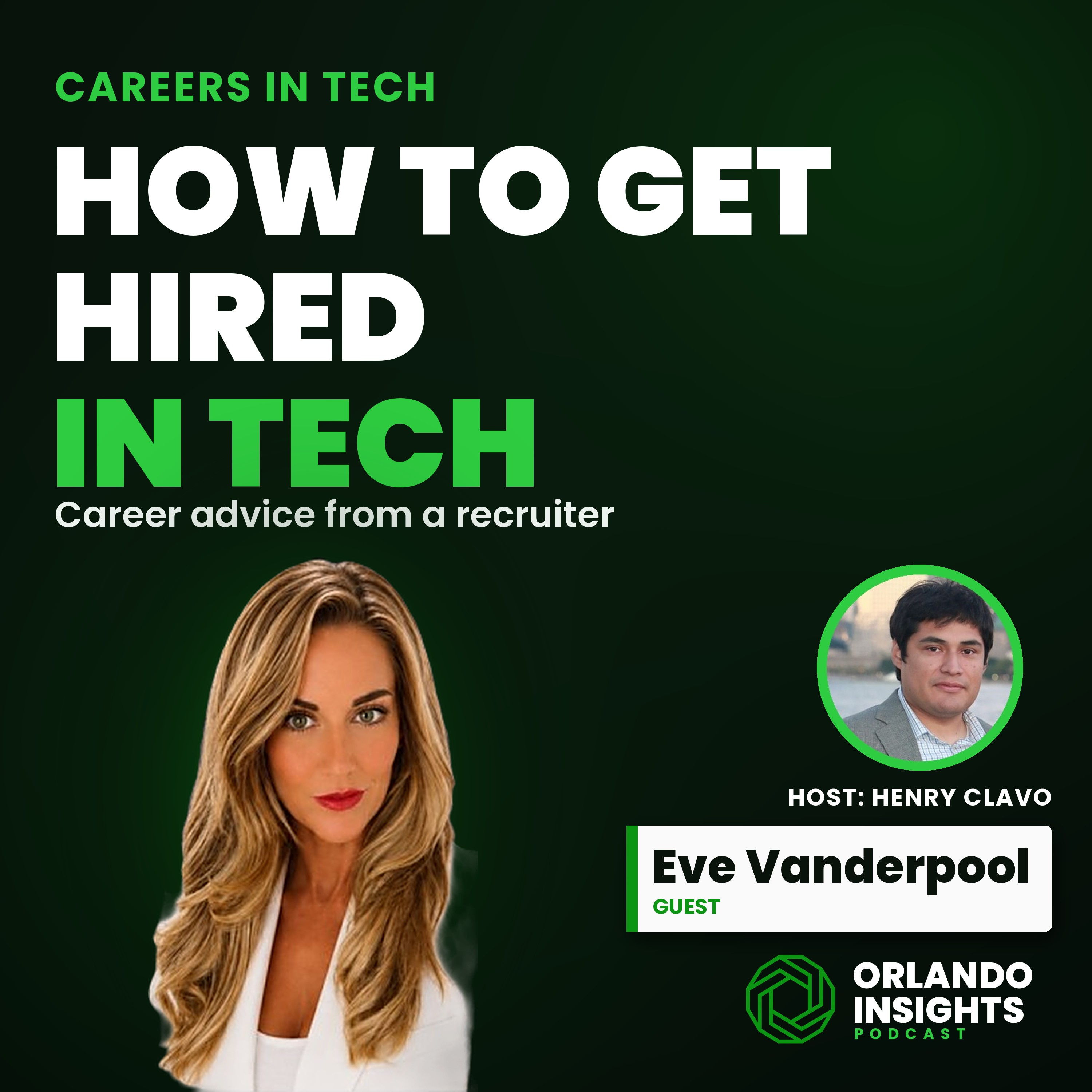
Eve Vanderpool
Guest
Henry Clavo | Orlando Insight Group
Host
 Spotify
 Apple Podcasts
 YouTube
 Castbox
 Castro
 Goodpods
 Moon FM
 Overcast
 Pocket Casts
 Podbean
 Podcast Addict
 Podcast Republic