Networking Without Keeping Score: How to Be a Giver, Not a Taker | Elena Raileanu
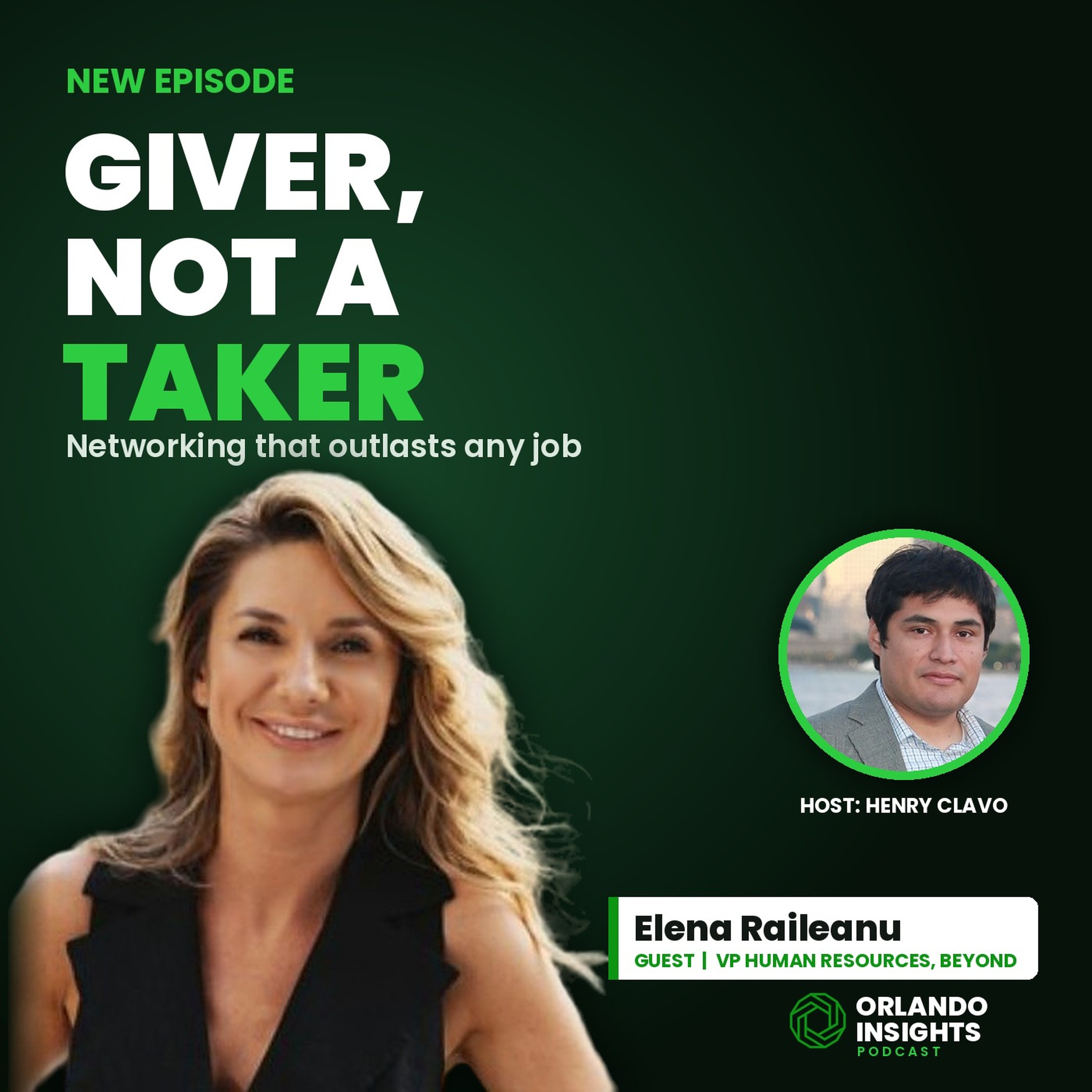
What does it really mean to network as a giver and not a taker? Elena Raileanu, a senior people leader and HR professional, guest lecturer at Northeastern University and former journalist, explains why relationships, not connection counts, carry a career.Host Henry Clavo and Elena cover how job seekers really land jobs, how to stand out at a career fair, how to use AI without losing your own voice, what to do when networking feels fake, and a simple six-week habit that keeps work relationships alive after you leave a job.In this episode:- Giver, not a taker: help when you can, never keep score, keep healthy boundaries- Secret keepers, matchers and givers: how Elena's students land jobs, and why givers end up happiest- Career fairs: be the 1% who treats the recruiter like a person- Five things to remember about everyone you meet- Using AI without losing your voice: Barbara Minto's pyramid principle- When networking feels fake: be interested, not interesting- Reputation, backdoor references and why gossip costs you- Layoffs and the six-week check-in that turns coworkers into friendsAbout the guestElena Raileanu is Vice President, Human Resources at Beyond (Beyond Mission Capable Solutions). A senior people leader and HR professional, she has experience across human resources, talent acquisition, organizational development and recruiting. She is a guest lecturer at Northeastern University, where she coaches students on networking, interviewing, job search and personal branding; a board member with Morgan Memorial Goodwill Industries; and a co-ambassador for Transform in Boston. She began her career as a journalist and has worked at companies including Liberty Mutual, Amazon and Citizens Bank.Find Elena: Elena Raileanu on LinkedIn (https://www.linkedin.com/in/elena-raileanu).Watch and listen to more episodes at https://orlandoinsightspodcast.com, on YouTube and on Spotify.The Orlando Insights Podcast is brought to you by Orlando Insight Group, data and AI advisory for CIOs and Chief Data Officers: AI Readiness Assessment, Data Governance & AI Foundations Sprint, and Fractional Chief Data & AI Officer. Book a free 30-minute AI readiness consult: https://calendar.app.google/xkJqUsFzrHAVkY4W7https://orlandoinsightgroup.comChapters0:00 Cold open0:19 Orlando Insights Podcast intro0:32 Welcome, Elena Raileanu2:19 Giver, not a taker: what it means to her4:08 Why your network matters most at your lowest6:18 Secret keepers, matchers and givers: who lands jobs8:35 Competitors who collaborate: the coffee shop study10:31 Why you should show up when you are invited11:39 Career fairs: be the 1% who treats recruiters like people14:17 Don't put decision makers on a pedestal16:17 Teaching at Northeastern: are students ready?17:28 Why names matter more than your code18:45 Five things to remember about everyone you meet21:26 AI and finding your own voice23:41 Train your AI: Barbara Minto's pyramid principle27:27 Personal brand vs. real relationships29:27 Turning LinkedIn connections into relationships33:11 "I hate networking, it feels fake"33:56 Everybody has a story: the journalist, therapist and giver hats37:15 Walking into a room where you know no one39:01 20 trusted people vs. 5,000 followers40:02 Reputation, backdoor references and gossip42:15 Layoffs and the six-week rule for staying in touch46:54 From child radio host to Boston: Elena's story50:18 Transform Boston and the January 9 event52:03 Where to find Elena54:44 Outro#Networking #CareerAdvice #HumanResources #Leadership #OrlandoInsightsPodcast
Transcribed automatically by PodView
0:00 So as soon as you can see your friends as friends and not competitors, everything changes. Because if you see your friends as competition, I don't know, it's kind of game over for everybody. So to answer your question, Henry, if somebody says it feels unnatural, because they behave unnaturally, because they don't have the natural curiosity. So sit there and look at the person and be like, okay, I know you have a story.
0:30 Hi, I am your host Henry Clavo, CEO and founder of Orlando Insect Group. Each episode we dive into real conversation with technology leaders, innovators and experts, influencers who are shaping the future of IT, data, cybersecurity. Our goal is simple, to give you practical insights, real-world strategies, and expert perspectives that you can use to drive smarter decisions and stronger results for your business. My guest today is Elena Reolimu, a senior people leader and HR professional with extensive experience across human resources, teleacquisition, organization development, recruiting, and leadership.
1:07 Throughout her career, Elena has worked closely with executives, hiring managers, employees, students, and professional at different stages of the career. But what really stood out to me about Elena is how she describes her philosophy, give her, not take her. She believes in listening, building trust, creating genuine connections, and helping others succeed. That philosophy extended beyond her work in HR, Alien has served for years as a board member with Morgan Memorial Goodwill Industries, is a global ambassador for Transfer Boston, and serves as a guest lecturer at Northeastern University, where she has helped students and early career professionals navigate networking, interviewing, job searches, and personal branding.
1:46 So today we're going beyond exchanging business cards and collecting LinkedIn connections. We're going to explore what it actually means to build a meaningful professional network, how to develop authentic relationships, how to give without making every interaction transactional, and how networking can shape our careers and why relationships we build may ultimately matter more than the numbers or connections we have. Elena, welcome to the podcast. Hi, thank you, Henry, for having me. Definitely.
2:12 So let's start with philosophy and then giver, not a taker. What does that philosophy mean to you, Elena? Yeah, I remember when I, since I was a little girl, I had this bad habit of like, kids would come to my birthday. And if another kid would comment on the gift that I was getting, I would re-gift it. And my mom would say, you can't do that. And I was just like, yeah, but if I have something and if somebody wants it and I can give it and I'm not really losing anything substantial, why can't I give it and throughout my teenage years and then being a young adult I oftentimes heard people say you have to start saying no more often you have to learn how to say no it was a big topic saying no saying no and I was like yeah but it's it's really easier for me to just say yes I will help you or yes I will help you not in this moment but later or I will help you with just this much, not as much as you want.
3:09 It's just no could never roll out. All right, the easier. And I looking back, I never regretted that because people had helped when I was a child, when I was a teenager, when I moved overseas. Now these people are successful. And guess what? We're friends. And, you know, of course, their success is shared with me too. And so if I can give any advice to anyone, it's okay to say no if you're being abused, if you're being disrespected, sure, it's a hard no. But if somebody has some sort of a need and you can help in some way, just go ahead and help it, help that person, and never look back and never keep score.
3:48 It always comes back to you in a good way. Yeah, I agree. Having the need to give but also have boundaries in order to be able to give. So that is very sage and wise advice. you're the one who just suggested as we talk about networking today why is this subject important to you Elena yeah because I am so grateful every single day when I look around me my biggest assets are the people that I have and even if in times when I found myself unexpectedly being laid off or I have some sort of a loss you know during those times you don't have the energy to like oh I'm going to pick myself up and I'm strong and I'm independent.
4:33 No, you actually need another human to talk to you and soothe you and validate you. And it is really awkward when you go through a tough time and call that person you haven't talked to in like six months or one year and be like, hey, Henry, do you remember me? But if you can sincerely say that when you are at your lowest in the most vulnerable times, you can pick up the phone and talk to at least five people to whom you can say, hey, I'm sorry it's three in the morning, but I'm having a rough time.
5:05 And you can be brutally honest with them and they'll listen. And then immediately their brain starts thinking, OK, what can I do for her? Who can I connect her with? So you can, if you can say that, then it means you have somewhat strong network and that takes time. So what I'm trying to say is really that we cannot move forward without other people around us. Yes, some people are very, very motivated. They have goals in life. So they'll study for an exam and not tell anyone. Or they'll have this career goal and they won't tell anyone.
5:37 And I find that those people get to where they want somewhat fast. But if they include others and share their goals with others and help others, they get somewhere fast, but also further, you know, because they get all this input. So be kind to other people. And that really, really comes back to you as well. Yeah, I heard an expression like if you want to go fast, go alone. Yeah, that was it. Yeah. Yeah. And it's interesting because I when I have my course at Northeastern University, sometimes I do a little bit of a data set and I I keep track of students who have successfully found jobs.
6:18 And there's three types. OK, there's the type that the secret keepers. OK, they don't tell anybody. They have like three roommates and their roommates don't know where they interview. And I find that these very motivated, very kind of secretive students find a job really, really fast. because they're so hyper-focused. But let's keep it there, right? And then the second group is like, oh, I have an interview and I failed the interview, but these are the questions I've been asked. I want to share with you so I can help you, right?
6:49 They tend to find a job a little bit slower because they split their attention between focusing on theirs and others. And then there are the givers. They a little bit forget about their goals, but they help everyone around them. And I have to say that working backwards, the givers are the slowest to get the job. But once they get it, they're the happiest because the job they find comes from a friend, from a referral, from their network. The ones that help themselves and others sort of like matchers, they find a job semi fast, but they're not as happy.
7:23 But people who keep it to themselves. And maybe that's just not how I've observed. You know, maybe not everyone is like that, but they tend to find a job really fast and then kind of quit the job later because it wasn't what they're looking for because they haven't shared with anyone, right? They haven't gotten input. You know, if there's maybe a red flag that you don't notice as a candidate, but your friend would. And so they are, they're missing out on those feedback and collaboration. Or simply that if they don't share that information, someone might get that opportunity and it might not also not work out for them that's the thing so that's a little bit of a takers mentality when you think well why would i share this opportunity with you if you and i are competing and it is quite possible we're competing because we're in the same class we are also roommates and if you get the job that it means i don't get the job and so as soon as you can see your friends as friends and not competitors everything changes because if you see your friends as competition i don't know it's kind of game over for everybody I can only speak for my side.
8:22 We're very competitive and we do like competition, but I noticed the opposite. It's very friendly, cordial and very supportive. Yeah. Have you heard of the study when they had two competing coffee brands? And I'm not going to say them because, but just think of like the most famous, right? So let's think of A and let's think of B, right? So some people are like, I only go get my coffee from A and some people, I only get my coffee from B. So the study was this on a highway, there was the coffee maker, you know, planted itself there.
9:02 So it had its shop there. And then the competitor wanted to build across the street and it did. So the question is, did they get more sales or did they get less sales? So what's your guess? If your competitor builds shop right across the street from you, do you think that you'll both lose money? You'll both make money or somewhere in between? I think they'll lose money. They'll lose money. And that study shows that they both want, they got more money. Because as I'm driving past A shop, right, I'm thinking like, oh, coffee, but this is not my brand.
9:40 But my brand is across the street. So the shop one triggers my desire to have coffee. Or if I go past B and I say, oh, this is I really want a coffee, but I don't want to go from buy from this brand. But the brand I want is across the street. So in that study, and I'm not an economics professor or anything like that, but it was really interesting to see how when competitors collaborate, they both accelerate and they both do better.
10:08 That's very interesting. interesting um yeah it is uh very touching and uh uh something that uh requires uh more study or more uh people recommending these uh suggestions noticing that yes yes that's true yeah it's a little bit hard to think that but i mean in general even when people make connections right somebody's invited to a birthday party or somebody's invited to an event the first there's two questions people ask one am i available and if i'm available who else is going okay very important okay so i'll look at it at 10 at least and i don't recognize the names and they don't seem important enough then i'll decide it's not worth my time because the question that i have in my mind is what am i getting if i go there if i get up i take a shower i do my hair i get my nicest shoes and I show up to this event, what am I getting?
11:03 And so it's really difficult to do that because most of the time you won't recognize the opportunity because you don't see it yet. And two, even if you go to that event and you have the expectation of what am I getting, you may not actually get anything, right? As you expected. And you might just have your whole, you know, fulfill your own prophecies that, you know, going to certain events is not worth your time. But I think when you're invited, when you, when somebody wants you to be there, unless it's terrible place, I don't know, very, very boring.
11:33 Pick up and go, you know, show up for them. So it seems like you've been studying this for a very long time. For a person who is new to networking or trying to get their foot in the door, obviously college students are struggling right now to get jobs based on research and data, what would be the mindset and what would be the attitude and also how do they should go approaching these events that come up in their area? Yeah, there's so many types of events. So let's think of the most, you know, the most classic one, job seekers.
12:10 When they're in school, they go to career fairs. And I've been to career fairs myself as a job seeker, but also setting up the booth for the company that I was representing. And so 99% of the students who showed up at my booth behaved in the same way. Hi, my name is Elena. And here I'm going to recite to you my entire resume from top to bottom, from bottom to the top and sideways in all the ways, because I want to tell you how magnificent I am. So from a person who is receiving all that, you see hundreds of hundreds of these different profiles, basically people acting and reciting their elevator pitch that they've been you know, preparing for a long time.
12:53 Now, how do you stand out? Right. So one way to stand out is to treat the person at the booth like a person. Okay. So how is it going? Beautiful booth. I'm sure it took you a long time to set it up. And you know what? Yeah, it did take me three hours. Okay. To get from my car to the tent, get the table, to get the cover for the table, to get all this beautiful pound plates and all this swag. Okay. So if you treat me as a human being, all of a sudden I see you with more interest, right? I want to spend more time with you than the next person who's reciting their resume.
13:25 Okay. So how is it going? Beautiful booth. I've seen other booths, but yours really stand out. Is this your first time at the conference? Okay. How do you find it? Is this the second time at the conference? How was this year different than the other So focus on that person for a little bit They don get the attention So focus on them and then find out about them what the company does And then you find the nugget all of a sudden they say they're hiring, and you'll find out that they need people who are, I don't know, I'm just gonna make it up.
13:54 But like, six feet tall, blonde with blonde, with blue eyes. Okay, so now you collect all this information. And when they're done explaining what you're looking for, then you say, I happen to be six feet tall. I happen to be blonde. I happen to be blue eyes as well. Right. So in this case, you're selling yourself, but in a more tailored way. So when I talk to students who are about to go to career fair, I say, you need to be that 1% that behaves differently. Another thing that happens is that they sometimes the job seekers who are more entry level, they see somebody, a decision maker, like a hiring team, and they approach this person as if they're a superstar, right so all of a sudden they go to henry and say i'm your biggest fan and i can't i'm dying to work at your company right then of course henry who is a is a ceo but also has imposter syndrome like all ceos all of a sudden he needs to rise up to this you know pedestal that so you you know come back as to like yeah i am a ceo and then so then you'll never make a connection because you all of a sudden you already created this big gap so um and so what what my suggestion is even whatever title a person has.
15:00 They have vulnerabilities, they have dreams, they have aspirations. So talk to them like a human being and be like, how is it going? How do you like this conference? Did you, did you try this chicken sandwich? It was really good. Okay. So, and then the person just responds to you that way. And of course they'll discover how smart you are through conversation later, but that initial approach needs to be human to human, not human to, I don't know, something different that you create in your head about that person.
15:26 Yeah. I get this advice or your advice where when you me a celebrity or if you meet someone famous you don't treat them or put them on a pedestal but you just introduce yourself and you act normal because you do that they put you in a category where you cannot escape from so i think that's very good advice being able to talk to them on the level that they can understand and they don't have to like show their ego in a way in a healthy ego in any way. Yes, yes, yes. And people feel that. People feel that you're treating them.
16:01 People feel that you have self-respect when they're approaching you. And so then you respond with paying attention to them and respecting them when you have a more harmonious conversation. Yes. So you mentioned you have students. How long you've been doing teaching and And how is your day-to-day working with students and prepared for the job market? And are they ready? Yeah, I am very honored to be a guest speaker very often at Northeastern University. And we talk about professional communication because that's a topic that is interesting, especially right now when AI writes everything for you.
16:44 And we talk about networking, resume writing, negotiating a salary. how do you deal with the rejection how do you prep your referral are they ready i think they're more ready than they think they are i remind them often that you know northeastern university is a very prestigious place and so everybody wants them to succeed okay if a recruiter can get picks up a resume and on top it says northeastern university they automatically cheer internally for this candidate right so their parents want them to succeed the teachers want them to succeed The only one who doesn't want them to succeed is the other universities, okay, because they're competing.
17:25 But other than that, they really – and then, you know, sometimes we have an exercise about remembering names. And so, for example, I'm sure you've been to a networking event when after a great conversation with somebody, they ask about your name. They're like, I'm sorry, I'm bad with names. And, you know, they ask your name. So I have them go through an exercise when they have to write some sort of HTML code or something, and they write the whole whiteboard. and then I have them write a five-letter name on the other side and it's Henry.
17:53 So I'm like, which one is simpler? So you remember this whole Python or whatever HTML, CSS you put in there, okay? And hopefully it works. But Henry was difficult to remember. And that's because you know that you're going to be tested on this Python and you're not going to be tested on Henry. And so people treat names a little bit loosely, even though it's one of the most important things in networking. Yeah, and this is a lesson I learned. You always give your name always to people because you never know that they might remember down the line, oh, this is Henry.
18:30 I met him. He's a nice guy. And they introduce you to your other colleagues within the office. And then once you do interview with them, they will consider you a positive influence. Yeah, yeah, yeah. Of course. The biggest goal when you meet somebody is for you to remember five things about them, the correct spelling of their name, their LinkedIn profile, where you met them, something very, very important to them. Let's say you're not into running, but they're prepping. They're training for a marathon.
19:04 Okay, so that's important to them. Maybe you don't care about running, but they care about running, and it's an important milestone. Then you make that mental note. and I forget about the fifth thing, but let's just say four things that you need to remember about them so that you can later follow up with the givers and not takers mentality. And I'm going to say, Hey, Henry, remember you met me at that conference, by the way, I'm looking for a job. Take a look at my resume. I cannot tell you how I feel about this.
19:31 Yeah, it's a tough one. And so it's a pity, right? But if the, if the person says, Hey, Henry, uh, how, how, you know, either how is your marathon training going or my friend just finished a marathon and they she told me some interesting insights maybe i can connect the two of you and so it's more like a givers that's that's always helpful and the five things that you want for sure for sure people to remember about you is your contact information doesn't matter your name your contact like how you can be fined.
20:07 Your profession. So for example, I work in HR, so I want to be remembered as an HR leader. And three more things. The fact that I'm nice to talk to, the fact that I'm nice to talk to, and the fact that I'm nice to talk to. Because later, somebody may say, oh, I'm looking for an HR director. And the person might say, oh, I know this person. I know she's really passionate about what she does. And she's really nice. Is she a good fit? They have no clue. Okay. Because maybe be the person is working in a different area they don't know if i'm a good hr leader i'm maybe the worst but because in my conversation with them i came across as a person they want to talk to then they'll refer me further as if they almost know how i would behave in a professional setting yeah it's uh usually in my industry they get frustrated they get the promotion they think their work speaks for itself but it's actually when you want to move into management you actually have to advocate for yourself and also be able to work easy to work with like you like you mentioned so it's something that uh goes over our heads uh people from my industry but it is uh it is very interesting that uh how that psychology works yeah um now let's let's uh move a little bit.
21:27 I want to talk about artificial intelligence, but now it's called superintelligence since this week. Yeah, really? I didn't know that. Yeah. Superintelligence, you can now write personalized outreach messages at a normal scale. Thus, authenticity becomes more valuable because it's getting harder to recognize. So I know, obviously, in your classrooms as a guest speaker, people use AI. How do you encourage them not to use that device and let them find their own voice? It's even harder now than before.
22:06 I think with every, oh my God, I hope this doesn't go viral in some way and then I get backlash. But here's what I'm going to say. Every single technology of advancement has some pushback. When I was, I forget, all of my relatives told my parents that this is the devil in the house and that it takes all of Elena's attention and she's going to be worse at homework. And no, Elena got better because Elena learned how to use Word and Excel and other things. And it was really helpful for her later in life.
22:42 and I think it's almost impossible to use AI without learning something I don't know even if you say hey I have a question for Henry and it's a delicate question I don't know how to ask and that's important because at least you have a conversation with yourself and with AI because normally we don't have that conversation you just boom boom and write it okay but here you You sit and you have a conversation and then you maybe talk to AI back and forth and AI has patience for you, which is good. And then when it writes, hopefully you learn something from there.
23:21 And then the more you help you use it, the more it helps you write better. I think I became a better writer with AI. Certainly more succinct, more clear. also so this is kind of like you allow ai to train you but you can train it back but what i want to say is that you can train your ai so for example my favorite framework is barbara mintos pyramid principle and um for example you're a very busy ceo and i know your schedule is wild and if i get if you get an email from me let's say i work for you and the email says henry i had a really long week and I'm very tired and I'm very hungry.
24:02 I'd like to eat something. I'm thinking about an apple. I want to buy this apple, but I don't have $5. Can I please have $5? By the time you get to that line where all I'm asking you is for $5, you get exhausted because I'm walking you through my tiredness, through my hungerness, hunger, right? But you just need, so it goes from like what I want from you to why I want it. And I just keep explaining myself, which is fine because people need context. What you have to do is just flip that pyramid. Henry, I need $5 because I would like to buy an apple because I'm hungry because I didn't eat all day because I was very busy because you gave me all these projects to do.
24:43 Okay. And I'm still giving you the whole information, but I'm just starting with what I want, or we should move this meeting. We shouldn't have this meeting. I can't, you know, this report is going to be late. This is incorrect. Your conclusion, your ask, your request, everything needs to sit at the top. And then all of your supporting data arguments need to sit at the bottom. Sometimes people don't even get there. Some people like to do that because some people say, I don't have enough context behind your request.
25:09 Here we go. The deeper you get, the more the context. But at least in the beginning, I told you exactly what I want. And I believe that's called like empathetic writing, right? You care about the other person. You don't want to waste their time. So going back to AI, sorry, I kind of drilled. You can take Barbara Minto's book, and it's free, and it's a PDF. Just load it into your AI and say, write this email and use Barbara Minto's pyramid principle. That way, you know, it reconstructs all of your brain thoughts into something that is easy to digest for the person who reads it.
25:49 But it goes both ways. AI teaches me and I teach AI.
25:59 I'll say this. We as humans are very lazy. So if you give us a tool to do it, we'll definitely use it. But it also takes away our voice and it will also become replaceable. So, i.e., I used to work with somebody who would have a training session and they'll show me how they take data and put it on a prompt and then let her rip. And then we will wait. That's not the way that that should be done. And also, being able to recognize your voice and having those difficult conversations, you have to have that ready.
26:34 Or how can you be prepared to face challenges outside of your comfort zone? So, yeah. It's true. I find that the more I write a certain way, the more I talk like that too. Somehow it trains my speech period, even if it's written or verbal. And I think the question is, can you leave without it? You know, if there's no clot today or no Chad GPT, are you feeling like you're working better or worse? I definitely feel like it's a setback. Yeah, I believe that we are losing our, not losing our abilities, just that we need to train back to what we used to do.
27:18 Research go to a catalog and pick those people up Yeah exactly Moving on I know that you are always on LinkedIn and focused on branding now this is the question for our audience who now or you could be a ticked out influencer you can be LinkedIn influencer have you have we become so focused on building personal around line that we forget how to build actual relationship what's the experience I think if the if your brand is different than how you show up in relationships I think then it's really tough to do that my personal brand is my professional brand I've always been a give and not a taker and luckily I've worked as a journalist I'm working in HR I'm organizing events I'm doing charity events as well So they're all kind of geared towards doing something for people.
28:19 So I don't have that struggle of, oh, I'm showing up a certain way in my brand, but I show up differently with people. Of course, I have my sad days. Of course, bad things happen to me like everyone else. And I have sad backs and I have disappointments and I have days when I'm like, wow, why am I doing this? and maybe one disconnect between my brand is how I show up with people is that in my brand I'll never put the negative things right because that's I keep that for a very select group of my friends and I will pick up the phone and I'll talk to them and that's probably the only thing that is different other than that I'm pretty much the same Elena you see me here or you'll see me on on LinkedIn on my videos, same thing.
29:08 Oh yeah, definitely. You're very lovely, very easy to work with. And I appreciate everything you've done for us. And we'll talk more about your background as a journalist, how that happened, but we'll tackle that toward the end. But once somebody connects with you on LinkedIn, how do they turn that connection into an actual relationship? or professionally, of course, and how should students and people listening be able to use the power of LinkedIn to their advantage?
29:46 I'll probably have to be negative for a second and talk about what not to do. Oh, go ahead. Maybe what not to do is helping because what to do is hard to say because it's up to every single person. And how you caught my attention is different than another person. And so that is personalized. But what a lot of people do that is common is, I don't know, it's almost like I see an ad every day. Have you considered this? Are you losing money? Are you making these mistakes? It's almost like every message I get is like, Elena, are you doing bad?
30:25 and then I have the opposite of like wow I love everything that you do and then nothing specific so you have this like let me save you and then this other one like I just want to tell you I admire your work but I have nothing tangible to actually point to so it's hard when you are reaching out to a thousand people I think that's the problem when I get these messages I understand that I'm one of a thousand. So if you really, really want to connect to somebody who is, who you really, really like, then you already know what to put in that message because you really, really like them for that reason.
31:03 Okay. So if you put an event together and it was helping kids and you raised, I don't know, $10,000 for that event for kids, and I admire you, I'm going to say, Henry, oh, wow, you raised $10,000 for this school. How amazing. By the way, I also do work with kids? Is there anything we can do together? You see, because I genuinely like you. I'm not looking at a thousand people and think, what can I like you for? I actually like you from the beginning, you know? So I think it's very, very hard to connect with a thousand people on LinkedIn.
31:36 If you are, if you just want to find a blanket message to everyone, it's tough. Yeah. Just, uh, I guess to take from your responses, just find one connection that actually is beneficial or message that you connect with on a values level and then professional level again angle for that i like that yeah i mean sometimes i get would you like to have a virtual coffee chat and things like that and you know most of the times i'll say yes to that because why not it's just probably like 15 minutes of my time and i find that every time you meet a a new person, you always learn something.
32:15 And if the person aligns with your values and goals and aspirations, then you can do something together. And if the person is at the total opposite of that spectrum, they have completely different political, economic, whatever social views, you still learn something from them. In fact, you learn more from them than your inner circle. So it's never a waste of time. So most of the time I do accept those virtual coffee chats more than I accept, hey, are you doing this wrong? Let me fix it. Or I really like what you do, but no specifics.
32:48 Very, very good. Very good. I like that. Now I'll have a thousand coffee chats. Well, you opened the floodgates. I have to put a filter for the word coffee. You know what? I don't drink coffee. I only drink tea. So if anyone really pays attention, they should offer me tea. that'll be that'll be nice uh what would you tell someone who says elena i hate networking it feels fake to me yeah yeah i have a lot of uh so sometimes i coach people in networking or how to get job and i just say well you can ask this or you can ask that on they say it just doesn't feel natural and i i completely understand and so look if if you're able to carry on a conversation with anyone, but you get to a point where you meet the new person and it just feels awkward is because you're not genuinely interested in them.
33:44 And I can tell you that not everyone is interesting from the start. And as in my time as a journalist, when I started at 12, I learned the hard way, really the hard way that everybody has a story, that everybody has a golden nuggets, but man, everyone has a thousand layers before you get there. so lucky for me is that you know when I was a journalist in a country where not everything was virtual so we had to actually book the van and book the cameraman and the lights and the everything so we drive for three hours to this village to do an interview and I sit down to the person and it turns out that they're not that interesting I didn't have the luxury to say okay guys let's go back you know I had to be there right because that's the only subject I have all week if I don't deliver this.
34:30 I have nothing. Right. So then you have to, then you have to sit down and kind of say, okay, I know there's more to this person. Everybody has a story. So how do we get there? Maybe this person feels like they have their guard up. Okay. Then you put a little bit of a therapist hat on. Right. So I have three, three hats, your therapist hat, your journalist hat, and your giver's hat. So if the person is going through, maybe they're nervous. Okay. You put your therapist hat on and you kind of mirror them.
34:52 Okay. You're nervous. This is difficult. This is the first time. This is not something you're comfortable about talking. And if they get more comfortable, then you put your journalistic hat on and be like, okay, I want to learn about your dreams. People love to talk about their dreams. Everybody has a little project, right? It's either a pet project or like a pet project, something they want to build or something they want to fix. So try to get to that because everyone will share something and maybe you have some ideas you can share with them.
35:18 Be careful about direct advice though, because you can sort of like let your advisory monster come out where like, oh, I can tell you what to do. So the best thing to do when you give advice to somebody who's going through a project is just say, like, I have a friend who did that. Right. So it feels a little bit more not as direct. So advice. Yeah. Unsolicited advice. Yeah. Oh, yeah. That's tough. Even if it's good advice, it's easier to say, oh, wow, this project that you're working on. I had a friend who did a similar thing.
35:47 And if you're off, which most of the time you're off, that's why you need to be careful with advice. if you're off at least you're talking to this other friend right about this other friend but if you're on point and it's there's really a good correlation between that project and this project then the person you're talking to will say oh really so they'll be curious in the last questions and they'll feel like you're helping them because they're asking that because you gave them a solidistic device so to answer your question hand rate if somebody says it feels unnatural it because they behave unnaturally because they don't have the natural curiosity so sit there and look at the person and be like okay i know you have a story let's just find it out what's your story okay and then as you find out then your natural curiosity comes out then your questions come out naturally and it's not about you it's not to be not you know you already know this is not about being interesting interesting it's about being interested and pretend you write a autobiography book about a person and you really want to find out their thoughts and aspirations and dreams and things like that.
36:48 I'm very interested in your time as a reporter and then when that changed you had a sudden had to shift or pivot quickly once you made it to the US. We'll talk about that later but let's finish with the networking. Another thing that people go to network events, like if you're at a conference where you don't know anybody, what's your strategy for walking into that room? either you can open yourself up so somebody approaches you and if you're standing alone and if you may be next to food or next to water or next to the book signing or something like that and if you're not closed and have all your legs closed and things like that somebody will come and approach you if that doesn't happen you can approach somebody who is alone right but also watch for signs and body language.
37:47 If somebody is hunched and maybe the legs are crossed, maybe it's not their day. Maybe they showed up there because they had to, but they don't really want a conversation. You can enter a group of two and you can just say like, I'm here to chat with you too. I'm Elena. It's very simple. And of course, people will open up and talk to you. I think body language is super important to just kind of watch if people are closing their legs. Maybe they wanted to have that one-on-one conversation and you just barged in.
38:14 But most of the time people are open to talking to you. And even then, you say your name, you say you're an HR leader, you're a professional accountant, you are a software developer, whatever your profession is, and that's it. And then you just think about, okay, how can I find out what's important to this person, how they want to be seen by me, how I can put them at ease if they share something vulnerable, how I can help them if they share that they're working on something. So I think three hats, right?
38:45 I think journalist, I think therapist, and I think giver. As long as you have these three hats on, people will open up and they'll talk and the conversations will flow.
38:57 Interesting. Good advice. Thank you. It's a network of 20 people who generally know and trust you more powerful than 5 000. i know i know that we have influencers 110k 20 000 but uh people that have 800 what's your take on that i think there's different ways to network of course it's easier to make friends in a smaller group like two true friends you can make friends amongst your fans as well also by thinking about what they want to see what what content you can share with them it's a different kind of friendship of course it's not as intimate but i think you can be successful at both you just have to think about what do you what can you share for your small group and what can you share with your bigger group of you know 10 000 followers definitely yeah yeah if you want to be influencer or not i guess if you share something genuine and make that connection i think that that matters um i'm curious about reputation what role does reputation play networking let's say good or bad and have you seen uh that have you seen a positive and a negative that's happened based on your experience working in this industry yeah i think trust is something that is hard to earn and sometimes easy to lose so So, yeah, and this is a very small world, not because there's, I mean, because there's more people, but also because people can communicate so much faster about someone.
40:36 It's very common to run a backdoor reference. So, for example, if I want to hire somebody and if I notice that they work at some company and I have somebody there, I will for sure make a call 100%. 100%. Right? So if the person did something terrible there, I mean, if it wasn't a match, no big deal. But if, you know, they really left a negative impression, then I will, you know, people find out through backdoor references. And I think that gossip is a currency that sometimes people use and it a bad thing right Somebody is not in the room Let talk about that person because we know something exciting And there this misconception that if I share something exciting, even if it's about another person, then it's going to make me more interesting.
41:27 And no, people take note of the fact that you are bad mouthing somebody else. And so, yes, I think reputation is important. And I think, you know, you can have a conflict with someone You can have a disagreement. And of course, people, when they exit these situations, everyone has their own story. So it's hard to control everything. But you can do your best to leave a long lasting positive impression with every conversation and relationship you have. Yeah, that takes discipline to be able to have a professional relationship with people that you don't like and be able to exit gracefully.
42:06 Obviously, the term professional, you know, don't take it personally. It's just a job. Yeah. It is very tough, though. I've been laid off twice in my life unexpectedly from jobs I really loved. And it's easy to say, oh, you know, it's just a job. It's more than a job. It's almost my identity. It's my paycheck. It's my relationships. It's my self-fulfill. So I go to work and I feel like I'm solving a problem, that I'm important, that I'm needed. So when somebody strips somebody from a job, it takes a lot.
42:44 Of course, I don't advise, oh, when you lose your job, go ahead and feel bad about it because I listed all these things. But if people feel like they've had a huge loss, it's because they've had a huge loss. Definitely. So, yeah, I didn't mean to gloss over that, but essentially some people work and dedicate their time. And sometimes that is not received positively. So it's just a mindset or direction that one takes. One will look at it as a goal, as a step in. So one will look at it as a relationship they build with the company.
43:25 but that concept is very uh 1970s uh but it has changed a lot now with gig economy you know you have these contractors i think it's changed but there's still this idea of loyalty to the company that that positive thing yeah and one thing one thing that i did always when i left the company whether it was me separating or I got laid off. You know how when you leave, if you're friends with somebody at work or closer, let's say you're not in the friend zone entirely, but you're really close, then they say, oh, let's keep in touch and let's keep in touch.
44:09 And what I see often happen is that they leave their personal email in Slack or they write this beautiful email that says, thank you. I've had a good time here. If you want to keep in touch and somewhere at the bottom will be their phone number. And so I find that that doesn't really work because you will hear from your coworker six months later when they need something from you. And of course, if you're a giver, it doesn't bother you. I have a different approach that worked every single time for me.
44:39 So if I have a good relationship with somebody at work and they said, let's keep in touch. And I say, Are you sure you want to keep in touch? Yes. Okay. So let's do this. Six weeks from now, I'm scheduling a zoom call or whatever video call, right? It has to be video call and we'll schedule it. So there's a cadence for every six weeks. And I'm not sure why I picked six weeks. I feel like you need to cut your hair every six weeks, you know, because otherwise you cut your split ends, you know, but I feel like a month is too frequent and two months is too, too, too long.
45:08 So six weeks is perfect. And long story short, hangry, every single person that I have set up these calls with have now become my very, very good friends. Because at first, you know, I leave the company and now they can be more open about sharing things with me. Right. And then they leave the company and they share more. And then we have this check ins every six weeks. We help each other. We truly keep in touch. So when I say that, you know, I worked at Amazon and I had, I was reporting into a hiring manager that we're really good friends right now, really, really good friends.
45:44 And it was because I suggested this cadence. He said, okay. And you know, once in a while, one of us cannot make it and it's fine. We don't need to put the effort into rescheduling it because it's already happening in another six weeks and that's fine. so I think that if you want to feel like you do lose everything in this company make sure that you set up a cadence with the person you like the most the people you like the most and you're not going to feel like you lost everything definitely yeah it really it takes work and uh thank you for bringing that up being able to know and develop that relationship cultivate that to be able to make your life better.
46:27 Yeah, yeah. A hundred percent. Yeah. And it's, yeah. People say yes, right? You pick the person who you know you have a good relationship. And they all say yes because it's not a big commitment. It's once in six weeks. We meet for 30 minutes. What's the worst that can happen? But you don't know that there's more to it, right? Lots of good things happen from these ongoing relationships. Definitely. We're almost toward the end, but I would love to hear the story of you being a reporter and then how you transitioned quickly from a reporter to coming here.
47:05 Yeah, so when I was 12, I got my first gig as a radio presenter. So I was just like reading from a script as a child. And then our radio station was here and then right across the bridge we had the TV station. so one time I was reporting on a graffiti competition and then the the team from the television was at the same place and they were missing their reporter and they overheard my script and they said to you can you read the same thing but like in front of a camera and of course as a child you have no fear right you don't care how you look and stuff so I was just like yeah sure so I did it and then they said do you want to maybe pick up a shift or two at the tv station I remember they there was a little bit of a fight for me like can we keep her the radio and we know we want to take her to the television so i lingered a little bit of the radio but then i i moved to the television i had a a kid's show and then i wanted to become a producer and have a little bit more speaking about having a voice imagine reading a script that is not yours like no word is yours like you have to read and pretend that's what you thought and so i wanted a little bit more autonomy and so i started being a producer that tv show and then later when i was 18 maybe maybe 17 yeah i i started working at a news agency and that was very good for me because i made a ton of relationships i learned a lot and at the same time me and my friends started a tv
48:26 show that was about objects and its history and innovation it's kind of like the object if you remember back in the day there was a show on national geographics no it was called how it's made that idea of how it's made but we added more things to it so and it was awesome and then at the same time in the summer i was working with people who had disabilities mostly deaf and hard of hearing and i was working with a sponsor from the united states and every summer they would say you should come to the united states i'm like nobody's gonna take me i am i am when one of the poorest countries in europe i don't make a lot of money i don't have property you know how you have to have a life to go back to.
49:07 Otherwise they don't give you a visa. So, but they said, oh, no, let's try. And so two weeks later, I have a visa and I have to go. I had to live my journalist life back, my family, my friends just fly here absolutely alone. So I came here and I started working with a nonprofit organization that supported individuals who are deaf and hard of hearing. I had to learn sign language really really fast and i was there for about six years and then i started you know thinking i could probably work in the corporate world so i worked for companies like liberty mutual amazon citizens bank so now i work here but yeah my life changed that's for sure you have a life here you're you're married and uh kids no no kids no kids but i definitely say sometimes people, when are you going back home?
49:56 I'm like, to Boston? I still find it funny that people think I should go back overseas because when I say home, I really mean Boston all the time. Oh, wow, Boston. That's good. I'm glad that you were able to find a new home or a home that brought you in. Yeah, yeah. Of course. I guess now we're concluding. I guess we can talk about the event that is coming up next year in Boston. Maybe you can shed a light on that. Yeah, of course. So I am the co-ambassador for Transform, the conference. And there's a big conference in Las Vegas every year.
50:40 And as a co-ambassador here in Boston, we're putting and we're scheduling mini conferences and socials here. We have a few of them a month. And most of the attendees are HR leaders, everyone from the C-suite or everyone who's interested in expanding their network and learning. And so super, super excited that we're having you and I are collaborating on this event January 9th. It's going to be at the Capiz Lounge in Seaport, my favorite area in Boston. And so we'll be inviting HR leaders, people from HR analytics, people who own companies, people who want to share with others, people who want to show up as givers and uptakers.
51:28 But, you know, drinks, food, a good time. Really looking forward to that. And thank you so much for supporting us in that event and being a sponsor for us. Yeah, when you mentioned you were doing good cause, supporting and doing things for charity and good causes, I wanted to participate in this came about. So we're happy Orlando Insight Group is able to sponsor this event. And our audience who is listening from the Boston area, please come and join us next year at the Cabiz Lounge. And DM Elena for RSVP, so we're in information.
52:03 and where can they find you, Elena, if they want to reach out to you professionally and as well as for the event? Yeah, LinkedIn is the best place. It's my first name and last name. And I know you'll post this on LinkedIn. So when you tag me, they'll find me. And any events coming up for you? Speaking engagements, any conferences for you? Yeah, I'm going to post on LinkedIn all of the remaining events that we have for Transform in Boston. We have a breakfast session. We have another social. We have a dinner.
52:41 We have a panel discussion at the Four Seasons. We have a ton. And I also noticed that you'll be speaking at an event next year. So maybe you can talk more about that. Yes. Transform in Las Vegas is a conference that is happening in April. I went two years in a row and the speakers are out of this world. And when I was selected to be a speaker, I was like, wow, this is a lot of pressure because of course, everyone is curated so carefully and everyone is so good. And I know that I will show up with a good and useful information for everyone.
53:22 But yeah, it's every year I go, it's an amazing conference, lots to do 150 sessions happening at the same time. You will never get bored. You just need to bring your most comfortable sports issues because things are moving fast. And you'll make a ton of friends, whether you're good at bad networking or bad at networking, you'll make friends because it's just, it's that sort of crowd. You know, everyone is there to share, just spend time together. You can miss it. And of course, if you come to my speaking session, please clap.
53:57 Elena, thank you so much. We couldn't get to all the questions, but we'll reserve that for when we're in Boston. So stay tuned for part two. Yeah, it was so nice talking to you. Thank you so much. Thank you for accepting my invitation. And yeah, we'll catch up soon. So this wraps up another episode of the Orlando Insights Podcast. To catch more conversations like Elena, please visit our website orlandoinsightsgroup.com and our podcast website orlandoinsightspodcast.com. Please like, subscribe. This will help us share with our community and also spread a message of these types of conversations.
54:39 So thank you so much. Have a good evening. Take care. Thank you. Thank you. Bye-bye.
54:54 you
Featured Guests
Elena Raileanu
Guest
Henry Clavo | Orlando Insight Group
Host


 Spotify
 Apple Podcasts
 YouTube
 Castbox
 Castro
 Goodpods
 Moon FM
 Overcast
 Pocket Casts
 Podbean
 Podcast Addict
 Podcast Republic