People Before Data Tools: An AI Reality Check | Ilya Vladimirskiy
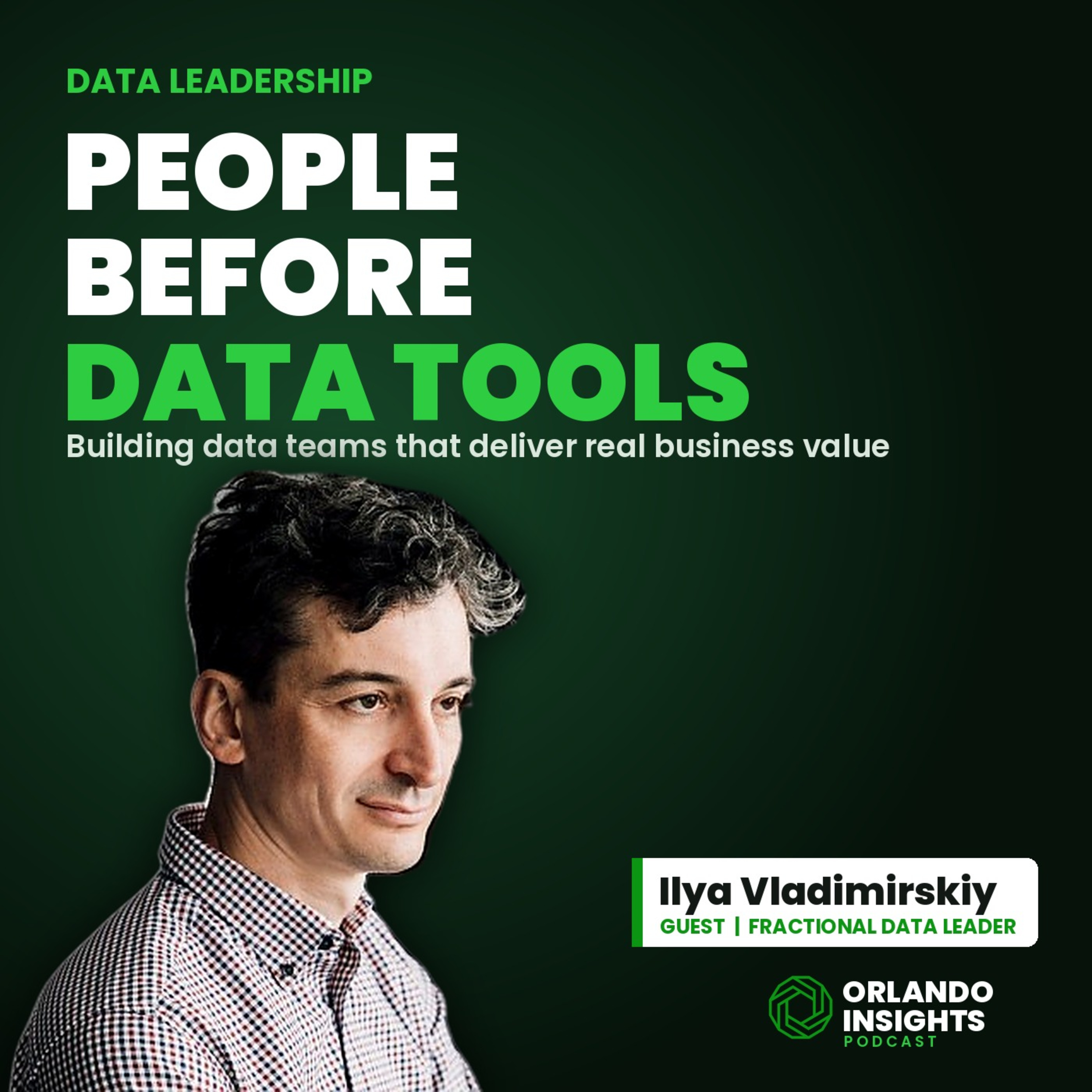
Why do data initiatives stall even with good tools? Fractional data leader Ilya Vladimirskiy tells host Erin Moody why the biggest misconception is that every company is already data driven, and why people come before tools.
Who it's for: Data leaders, executives and teams whose data initiatives stall even with good tools.
In this episode you'll learn:
- Why "everyone is data driven" is the biggest misconception
- Why data work is about people, not just tools
- Hiring for attitude and culture fit
- Why to take time before proposing change in a new organization
- An AI reality check: why it is not a silver bullet
Ilya covers how he embeds quickly in a new organization, hiring for attitude and culture fit, taking time before proposing change, and a reality check on what AI can and cannot fix.
Chapters
0:00 Welcome and introduction
2:00 The biggest misconception: everyone claims to be data driven
5:40 Why data work is about people, not just tools
9:20 How he works with clients as an independent data leader
11:14 Hiring for attitude and culture fit
13:01 Questioning the plan before hiring a big team
14:42 How he embeds quickly to create impact
18:35 Take time before proposing change
20:19 An AI reality check: not a silver bullet
22:17 AI, smaller teams and new jobs
27:02 Where to find Ilya
More episodes: https://orlandoinsightspodcast.com
Guest: Ilya Vladimirskiy, fractional data leader
Hosted by Erin Moody for Orlando Insight Group. Henry Clavo, Founder & CEO: https://www.linkedin.com/in/henryorlandoclavo/
The Orlando Insights Podcast is brought to you by Orlando Insight Group, data and AI advisory for CIOs and Chief Data Officers: AI Readiness Assessment, Data Governance & AI Foundations Sprint, and Fractional Chief Data & AI Officer. Book a free 30-minute AI readiness consult: https://calendar.app.google/xkJqUsFzrHAVkY4W7
https://orlandoinsightgroup.com
#DataLeadership #DataStrategy #OrlandoInsightsPodcast
Transcribed automatically by PodView
Hi everyone and welcome. I am your host Erin Moody here on behalf of Orlando Insight Group. Each of our episodes we dive into real conversations with technology leaders, innovators, and experts who are shaping the future of IT data and cybersecurity. Our goal is simple, to give you practical insights, real-world strategies, and expert perspectives that you can use to drive smarter decisions and hopefully get stronger results for your business. Thank you for tuning in. And I'd love to introduce you guys to today's guest.
We have Ilya, who is a seasoned data leader, advisor, and all-around tech strategist who's helped companies across industries build smarter, more impactful data teams. He has over 20 years of experience in engineering and over a decade in leadership, and he brings a refreshingly practical approach to data. He doesn't think it's all about fancy tools. It's about real business value and strong people. He's led teams at places like Ada Health and Carfax. He's taken time off for paternity leave with intention, which I love.
And he supports organizations now as a fractional CDO and data architect. So thank you so much, Ilya, for joining us today. Thanks a lot for having me and looking forward to the discussion. Awesome. So we will jump right in. Obviously, you've got a ton of experience, so we want to pick your brain about as much as we can fit in, about 30 minutes or so. So first question. you've led data teams anything from startups to global companies can you give us the biggest misconception in your eyes that businesses have when trying to do data right i think the biggest misconception i experienced is that every single company you talk to pretends to be data driven like everyone because at some point somebody said it's good to be data-driven.
So every company says we are data-driven. To start with, looking from today, I'm not even sure that being data-driven is always good because all successful entrepreneurs say you need to trust your gut. You need to have the data, but sometimes, especially if it's innovation, especially if you're solving a problem people maybe never solved. You need to use data, of course, but sometimes you need to ignore the data and just follow your gut feeling. And so I would prefer maybe something like data-informed decision-making.
You still need data. You don't want to guess, but that doesn't necessarily drive you. Nevertheless, even if people say they are data-driven and they hire huge data teams and let them build huge dashboards, some people never look into these dashboards. so when I when I joined the company I tried to find out like who is advocate for data here or who is a sponsor on a leadership level and often times you need to know who really uses data for decision making or for the daily work and who not and you need to find your sponsor you need to plug to the right person it can be a CFO or it can be a CO or it can be even a CTO or and it's not necessarily the C-level data team reports to.
So I think the misconception is really, we need data, we use data, but if you start asking how do you use data, it's rarely that people have an idea. Yeah. Yeah. Yeah. It's probably coming from the previous buzz around big data or data science where everyone said data is so important. Right. And then storage became super cheap, So people started to store everything with a hope we will later generate some beautiful insights out of it and business value. But this later never arrived. And now seems, yeah, now like AI is there.
So, yeah, I would say this is basically the misconception. Everyone believes they need data and they use data, but it's rarely the case, to be honest. Yeah, that makes a lot of sense. And when you said that, I was just taken back into probably every corporate job I've ever had. And I remember a couple of occasions having to make like these super detailed data spreadsheets because I worked in like HR and recruiting. So they would always want to know what's going on. And in both of those cases, these reports that took forever to put together because you're pulling from all these different sources, they just stopped one day like nobody ever looked at them so yeah that makes a lot of sense like it's a lever you need to consider it you can't just ignore it but use it as you know a part of a whole picture definitely yep very cool all right um so one of the things that i've um that I've seen you kind of say or talk about is that data isn't just about the tools, it's also about people.
Can you talk to us a little bit about what you mean by that? Maybe give us an example if you have one? I think this comes with some experience, at least in my case. If you would talk like 15 years ago, I would probably say 80% tools and technology and 20% like business or team structures and people. Now I would probably assess other way around. So I think, of course, you need a solid understanding of technologies and tools. But I rarely saw projects failing because of technology. So actually, we have such a bright choice of great tools out there nowadays, that it doesn't really matter if you do Snowflake or Databricks or Google or whatever.
In many cases, pretty much every technology will do the job of course you need to know the differences you need to understand like more or less pros and cons but where it is really critical and what makes it or breaks it is people because like people who work with this technology so I would say I always started with people when I was employed first week seven months maybe I mostly spent building relationships understanding how people work together like what they want what is their motivation i it depends a bit on your like level of an organization of course if you are an engineer people expect you to be hands pretty quick but if you are like more leading a team or managing managers who lead who who lead the teams you probably have some space for that And I think looking under the hood and going deep into technological things is overrated honestly.
Don't get me wrong. Don't get me wrong. I'm not saying you don't, as a leader, you don't need to understand technology and what people are doing. Because this happens as well. Some people come from a business side. They have really very smart people. They have a lot of knowledge about business, but they have a hard time understanding what are the technical struggles people are having. And then it's always a balance. But all in all, I would say, yes, people first, then probably followed by organization of work.
Are they centralized? Are they decentralized? How they work together? What are the methodologies? And at some point, tools become important as well, of course. but it's not a critical part in my opinion. Yeah, that makes a lot of sense. I think that with everything that we've got going on, we always have new tools. We've both been working for quite some time and we've seen lots of things over the years. There's always going to be new tools that are gonna get better and better hopefully, but we're still gonna need the people to have the strategy and then also understand the tools.
I love that. Yeah, yeah, yeah. Awesome. So in your work, you do a lot of building and helping companies get their data teams started from scratch, from zero. What do you look for when you're building those teams and advising these companies? And are there any red flags that you spot early on that might help someone listening? Yeah. So maybe to start with, just to give some context, I spent most of my career working in permanent positions, like being employed. So this independent contractor way of working is relatively new.
It's almost a year, I think, since I moved freelance. and it depends on the needs of a client. So it's not necessarily starting new teams. Sometimes it's about like scale-ups who want maybe to bring their teams to the next level. Sometimes they do have something and they just need somebody with experience to help them improve. Sometimes it's about regulations and like regulated industries. I did a few things in e-health biotech recently. So some people are just looking for some expertise on how do we deal with sensitive patient data or some regulations we need to meet.
But I would say everything around data platform and or data team is possible. So it can be like very technical job. Like my current project, I started as a data architect, individual contributor, like helping them to design and build. And then I moved into like back to more people manager role, like now I'm overseeing the engineering teams. But all in all, sorry, your original question, like what are the red flags, right? So I think, again, like plugging, like maybe attached to what I said before, if I hire, like I definitely look at attitude and soft skills.
Right. Not solely, you need to bring some level of expertise, but I am more willing to make compromises on technical topics than on people or communication. I think, I strongly believe it's difficult to change behavior of an adult person, especially if the person doesn't want to change. So it's just risky for a company, like hiring somebody where you have concerns about attitude, cultural fit or communication skills. it's much more risky than hiring somebody who maybe is not perfect in a technology you use, but you're not probably, in the best case, you're not hiring for a few months.
You're hiring for like many years and you can give a few months to get up to speed in a technology. So I think all in all, red flags, if you mean the candidates are just, yeah. So I'm looking for like good engineers or analysts and the rest hopefully comes. I try to get close connection between business and technology, like avoid building something in isolation and showing after many months of work, showing results. I don't think it works, especially in data. I am cautious like when companies are overhiring and like getting a lot of data people because I need to see a reason.
I need to understand like where they're heading with all these people. You mentioned Carfax. I was leading the data team of the European subsidiary. It's a much smaller company, so of course it's not the same scale as the U.S. Because the idea is not that common in Europe to pay for vehicle history reports. And secondly, because of GDPR and all these regulations, privacy regulations, it's much, much more difficult. Makes it more complicated, yeah. Exactly. But what I'm trying to say, that company does money with data.
They buy data about used cars and they sell it in form of vehicle history reports. And obviously, half of their technology team was data and it was a big part of their business. In this case, I understand it. But if you have a small startup with like 20 people in technology and then they say they want five data engineers, I would question this. Like, why? I don't want... I'm a data guy. I'm happy to hire five great data engineers, but I don't want to fire them six months later because suddenly they realized they don't need to build things.
Yeah, I mean, that is definitely refreshing to hear. I mentioned before I was in HR for a long time and unfortunately had to do a lot of playoffs. So it's not fun for anyone, no matter what side you're on. And so, yes, I hope leaders hear what you just said. It's better to slowly hire, I think, because you can, you know, figure out what you need. And like sometimes you don't know that until you hire a few people. And especially, I would imagine, with a startup. I would say, sorry, Erin, I would say it can be quick, but you need to have a plan.
You need to have a solid plan and you need to know what you're doing. and preferably it should be sustainable so that you don't need to downscale because it's very easy to upscale downscale like cloud services but it's as you just said like downscaling people is yeah it's not something which impacts impacts real people yeah you you don't want that exactly exactly um so kind of touching on something that you you mentioned so you uh you work as a fractional data leader So with that you not a permanent employee The companies know you not going to be there long term So how do you embed yourself into an organization quickly enough to create impact?
Okay. So I had different models and actually it can vary from like interim full time, let's say three months six months nine months up to uh like fractional more advisory i think it really depends on the needs i would always try to find a model which makes sense um and to your question i didn't change jobs too often i think like on average i stayed two three years in some companies like five and some a bit less than two. So I have, from my previous career, I have some experience of like integrating into new teams or taking over like leadership of a team.
I always start with people. I always try to understand, learn more about them. I'm just junior. I'm really interested in people and like what they do. And I try to find out what motivates them to be here in this job. like what are their goals, maybe even some hidden agendas, not necessarily negatively. I mean, maybe you have a data analyst who wants to move towards data analytic engineering and tries to join a project, but before you talk to her, you would never know, right? So I think it's important to establish a relationship where people trust you and tell you things, especially if things go wrong.
If you are doing something wrong, something they don't like, with whatever issues they have. So I'm more on the servant leadership side of the things. I try to find out what is the low-hanging fruit, like small change I can do to help people to improve their daily lives in work. And then it can be talking to a complicated stakeholder. It can be like introducing a process. It can be hiring, if they say lacking skills, pushing back on some requests from a business. I mean, it really depends on the team and on the request.
So how to make it quick? I don't think I have a good recipe because it's heavily. Yeah. But the way you said you approached it, like that makes sense. Maybe. Yeah. Yeah, yeah. People want to be heard. People want you to help them solve the issues. They don't necessarily need you to tell them what to do and how to do it because they know it if those are right people. If those are wrong people, maybe there is no way around and you need to change the people. That happens sometimes. But assuming that those are the right people and the right team, I think they know what they're doing and you actually just need to tell them where you want and you need to provide them safe space to thrive and to remove blockers from their way.
So define the boundaries, what's good, what's bad, set the goal, and, like, actually step aside. Give them room. So, and I think, yeah, that's basically the general approach.
Yeah, I love it. Yeah, yeah. Don't, and maybe last thought, don't jump into actions or into conclusions because it's natural. like if you see things are built in a very weird way sometimes you have like you want to criticize you want to give some negative feedback about some engineering practices but you don't know the history you don't know the context you don't know why things are like they are and i think before you understand all the context it's better actually not to come with ideas or suggestions so you really need to take like some time and promise yourself not to start changing or offering change before this time passes yeah that that's great advice um whether you know someone's listening to this and they're thinking about going into consulting or what have you but it's also just good practical advice anyway um people tend to be wary of change so if you come in like bulldozing with all your ideas and telling them what they're doing is wrong, like that will typically cause a defense mechanism in people.
So I love your approach. And we think we could learn a lot from that. All right. So I think we have time for one more question. So I am curious, AI is one that we talk about a lot on our program. And obviously, it's the new buzz. We were talking about data-driven before. Now everybody's AI with their companies. I was curious to you to hear your perspective on your thoughts on maybe where opportunity could lie for people using AI that maybe they haven't thought about. Anything from your background that you wanted to touch on from that standpoint?
way well um i am normally when when i i run into discussions about ai and this is approximately 10 times a day i i i i try to do two things like first to get people back to earth like no it won't it's not a silver bullet no it won't make miracles no if you don't know what's inside databases and nobody can understand ai will not magically solve it so i think just getting back to reality and like maybe it's a reality check right it's a very powerful technology which we all should leverage and use right but it has its limitations and you need to understand where it's good and where not a second thing i try to basically always advocate for is remove this drama part of it.
Like, no, it won't take our jobs away, at least tomorrow. Oh, right. Yes. Hopefully. Let me give you an example. I was generating a picture for LinkedIn, and I asked for a picture of a person in a plane. And it made a picture with a belt, which looks like a car belt. And I told it, can you please fix a belt? It doesn't look like a plane, like it should be a plane and it made two belts like really i'm not joking like two two car belts next to each other and it was chat gpt actually expensive like one of their best models and right and i'm okay this thing is supposed to replace me tomorrow in what i do let's see yeah so of course it changes the way we work of course you need to be mindful but there is no i'm a techno optimist you know it might take away the jobs not because it will replace people because the whole world economy is in a recession and there is less needs for businesses and less investments yes so also like we are not white colors anymore in it and we are like blue color so we should just get used to layoffs and like like all this you know google style offices might be almost history for many people.
Right, right. But nevertheless, I think AI will also produce jobs and I think companies will get smaller. Many projects, many early stage startups will not hire big tech teams anymore. They will hire senior people to help them, maybe also fractional or interim to kick the things off, to pick the right technology and they will leverage AI. Teams will get smaller but much more people will try new ideas and start new businesses. So maybe in total, we will still have same or even bigger demand on engineers.
So I would just advise everyone not to panic, not to panic, learn, get better in what you do, understand the limitations of a tool, like work with it. I think good engineers work with it daily. But, you know, just closing, I saw both. Like I saw people who were very junior. They thought they can do great stuff with AI. They generated a lot of code, put it into production, like advised their companies to go live with it, and then had security issues. They had cloud cost issues, like customer complaints.
And I saw people who worked many years for big tech, like Amazon, for example, and now they use it and they are so much more productive. So they generate some code and then they go through every single line of this code. They understand exactly what it does and make improvements because if you take away ChatGPT, they would probably be better. They can do better than ChatGPT and then it helps you. If you cannot do better than ChatGPT, it's dangerous. Yeah, it's good to learn, but it's not so good to produce production code sometimes.
Yeah, I think that makes a lot of sense. The person that has experience in what it is that they do, they're going to be able to talk to CHAP-GPT in a different way than someone, you know, like a new college graduate or something. They're not going to have that background. They'll have, like, the schooling, but they haven't, you know, been doing it for a decade. You're right. Yeah. And I was just going to say I'm with you on, yeah, 100%, some jobs will go away because of AI. It's just, but that's always been the case with new technologies.
And the companies will have to hire new roles that, honestly, we probably can't even comprehend right now. So there will be new industries. There will be new tracks. So I'm with you. like the fear, it's like we talked about before, it's change. But I think as long as you do what you pointed out, continue to learn and adapt, then you'll be right for the new opportunities that come and probably look a little bit different. I agree with both things you said. So I think it's true for all industries or like for all user groups.
If you know what you're doing, if you can actually, if you're an expert, then it's a very powerful tool. which takes away a lot of manual work. If you are not an expert, then use it to learn probably. And second thought, second thing you said about jobs disappearing, remember going to cloud. System admins jobs or people who manage servers or buy servers for companies, physically build them in the company offices, they don't do it anymore, but these people are still around. They just manage cloud services.
exactly right right yeah i saw it um especially i used to work in an investment bank and they constantly reorganizing um they were european companies they actually did pretty good with um finding people new jobs within the new um so a lot of our us companies aren't aren't um i would call strategic because it actually saves you money in the end to do that but that's neither here nor there but i can tell you like over i worked for them for a decade and And just like you said, new things would come.
Teams would get impacted. But then, oh, there's this other new department coming that your skill set would be fantastic for. And, you know, everybody's having to learn it anyway because it's a new thing. So, yeah, I think that. I think this is a perfect setup, yeah. It's good if it works this way. Yes. Awesome. All right. Well, thank you so much for joining us today. for people that have enjoyed our conversation, if they're interested in following you, connecting with you, what's the best place for them to go?
So I'm actually doing LinkedIn, like probably the one and only place I am present is LinkedIn. It changed recently from being just a database of my contacts and friends and ex-colleagues to more a stage where I present myself. I like to share ideas or something I learned. I'm still looking for a balance between jokes and memes and some serious posts. But yeah, technically I have a YouTube channel as well, but whatever I post there is also on LinkedIn. So I think LinkedIn would be a good start. You are more than welcome to follow me, give me some feedback.
Also, if you want to connect, I'm happy to connect. Just please write a note with your connection request. Like if I know who it is and what's the reason, it can be any reason, but I just want to have some personal part of it. Yeah. And then I'm really happy to connect as well. Awesome. Fair enough. So send him a message telling me you saw him on our podcast. Awesome. All right. Well, thank you so much. It was great chatting today. You really delved into a lot of information. I think we learned a lot.
So appreciate the time.
Thanks a lot. The pleasure was mine. And yeah, good luck with your future episodes. Awesome. All right. And so that is it for today, guys. Thank you so much for hanging out with us. And if you enjoyed our conversation today and you want to hear more leaders like Ilya talking, please make sure you follow our page at Orlando Insight Group. We always post our new speakers and we post lots of other information there as well. So make sure you give us a follow. All right. Thank you so much. And see you next week.
 Apple Podcasts
 Castbox
 Castro
 Goodpods
 Moon FM
 Overcast
 Pocket Casts
 Podbean
 Podcast Addict
 Podcast Republic
 Spotify