Small Language Models, LoRA Adapters and AI Agents: A Microsoft Intern's Story | Orville Daley
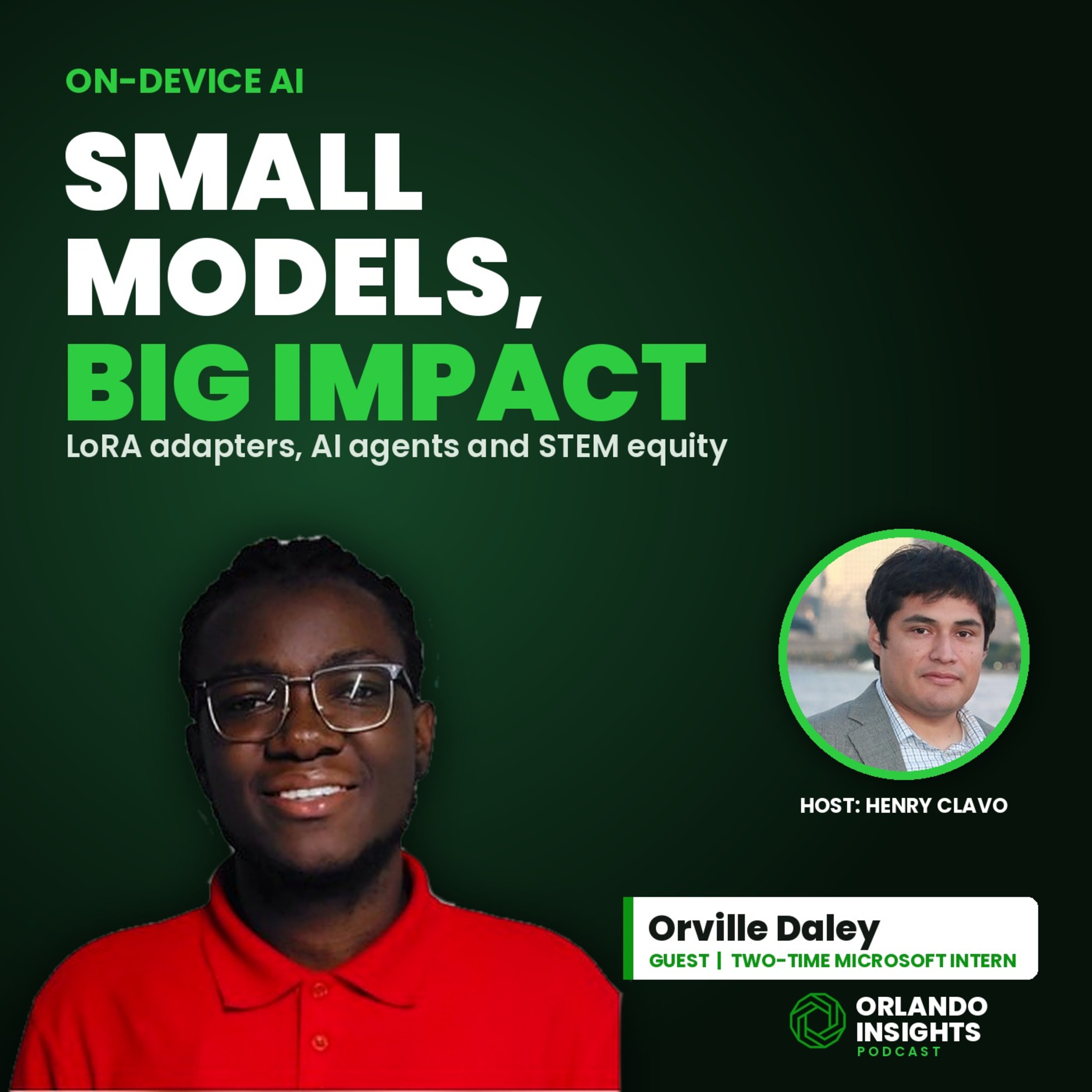
How do you get a small language model to reliably call tools on a PC with no internet connection? Orville Daley, a two-time Microsoft software engineering intern and STEM equity advocate from Jamaica, tells host Henry Clavo how he built an agentic AI starter kit for Copilot+ PCs using Phi Silica, MCP and LoRA adapters.
Who it's for: Students and early-career engineers, AI and software developers, anyone curious about on-device AI, and leaders working on STEM access and equity.
In this episode you'll learn:
- How Orville went from wanting to be a doctor to robotics, after a national coding competition win got him recruited to his school's robotics team
- Why the gap for first-generation students is not ability but access to opportunities
- How he planned a 12-week exploratory internship with only a start and a theoretical end, and why he sent his manager daily updates
- Why chain of thought can waste tokens on small language models
- How he spent about three weeks getting Phi Silica to respond with only a tool call, and how LoRA adapters fixed it
- How semantic search narrowed hundreds of MCP tools down to the five most relevant
- Why he expects AI to get both bigger in the cloud and smaller on devices, robots and phones
Orville explains LoRA (low-rank adaptation) adapters in plain English, describes presenting his project to two OEM partners who liked that it ran on the device with no internet access, and shares how Jamaica's national robotics program invites every school on the island to nominate two students, coaching around 45 students a year who then go back and build or improve their schools' teams. He also talks about splitting his time into need-to-do and want-to-do, and his goals for the next five to ten years in software and robotics engineering.
Chapters
0:00 Cold open
0:16 Orlando Insights Podcast intro
0:57 Meet Orville Daley
1:57 How we met on the Seattle light rail
2:53 From aspiring doctor to robotics and AI
5:36 First-generation student: access, not ability
8:07 Two Microsoft internships and learning MCP
10:50 Managing an exploratory project with no goalposts
14:21 Building an agentic AI starter kit for Copilot+ PCs
17:17 Getting a small language model to call tools
19:13 System prompts vs LoRA adapters
21:37 LoRA adapters explained simply
23:45 The future of AI on edge devices
27:26 Removing barriers to STEM in Jamaica
29:15 Balancing school, work and mentoring
31:12 Spreading Microsoft opportunities across the Caribbean
32:18 Goals for the next 5 to 10 years
34:34 Where to find Orville
34:56 Outro
More episodes: https://orlandoinsightspodcast.com
Guest: Orville Daley, Software Engineering Intern at Microsoft (two internships), FIRST Global alumnus and coach on Jamaica's national robotics team
Host: Henry Clavo, Founder & CEO, Orlando Insight Group: https://www.linkedin.com/in/henryorlandoclavo/
The Orlando Insights Podcast is brought to you by Orlando Insight Group, data and AI advisory for CIOs and Chief Data Officers: AI Readiness Assessment, Data Governance & AI Foundations Sprint, and Fractional Chief Data & AI Officer. Book a free 30-minute AI readiness consult: https://calendar.app.google/xkJqUsFzrHAVkY4W7
https://orlandoinsightgroup.com
#SmallLanguageModels #STEM #OrlandoInsightsPodcast
 Apple Podcasts
 Castbox
 Castro
 Goodpods
 Moon FM
 Overcast
 Pocket Casts
 Podbean
 Podcast Addict
 Podcast Republic
 Spotify