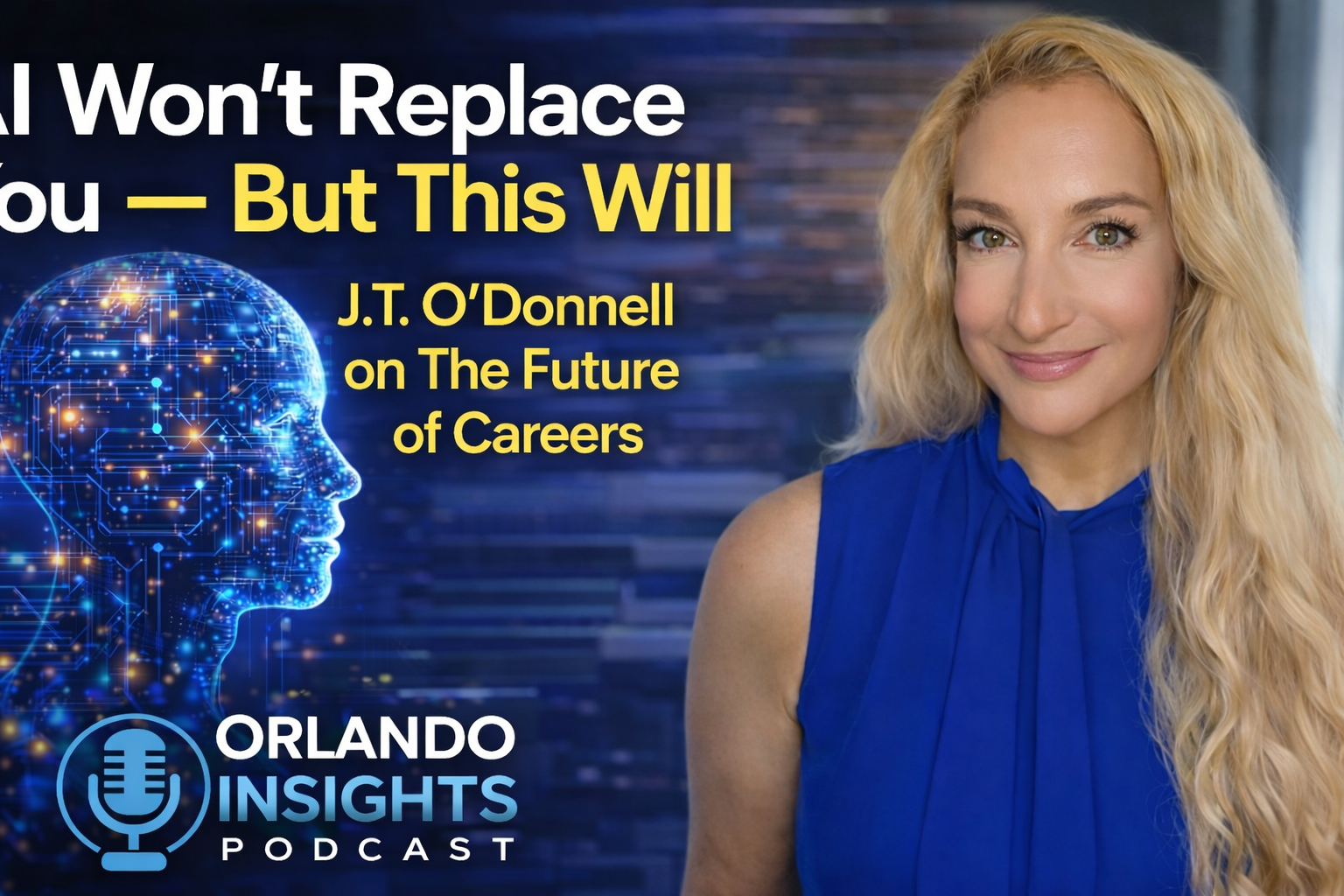
The Real Threat to Your Career | Why AI Isn't Your Enemy (But Complacency Is)
Related Episode
How to Stand Out in an AI-Driven Job Market | J.T. O'DonnellLet’s be real for a second: you’ve probably scrolled past at least three articles this week claiming that AI is coming for your job. Maybe you’ve even felt that little spike of anxiety. “Should I be worried?” “Is my career obsolete?” “Do I need to learn to code right now?”
Here’s the thing—you’re asking the wrong question.
On the latest episode of Orlando Insights, we talked with J.T. O’Donnell, Founder of Work It DAILY and ProVoices, about what actually threatens your career in today’s tech-driven landscape. Spoiler alert: it’s not the robots. It’s something far more controllable, and honestly? That’s actually good news.
The Narrative We Need to Stop Believing
There’s a pervasive myth floating around that AI is coming to replace human workers wholesale. It’s the stuff of sci-fi movies and viral LinkedIn posts. But here’s what J.T. brought to the conversation that cuts through all the noise: the threat isn’t AI itself—it’s resistance to it.
Think about it. Every major technological shift in history has sparked the same fears. The printing press would destroy scribes. Factories would eliminate craftspeople. The internet would make brick-and-mortar retail extinct. And yes, some jobs changed. Some roles evolved. But you know what? New opportunities emerged too. People who adapted didn’t just survive—they thrived.
The same is happening right now. The professionals who are panicking aren’t panicking because AI is inherently dangerous. They’re panicking because they’re not sure how to work with it instead of against it.
What Actually Keeps You Competitive
So if AI replacement isn’t the real threat, what is? According to J.T., it comes down to a few critical factors:
1. Your Willingness to Learn and Adapt
The career landscape is shifting faster than ever, and the professionals who stay relevant are the ones who treat learning as a non-negotiable part of their job—not something they do “someday.”
This doesn’t mean you need to become a data scientist overnight. It means staying curious. It means experimenting with new tools. It means asking yourself regularly: “What’s changing in my industry, and how do I need to evolve?”
2. Understanding Digital Transformation, Not Just Tools
There’s a difference between learning how to use ChatGPT and understanding why digital transformation matters for your career. The former is a skill. The latter is strategic thinking.
Digital transformation isn’t just about technology adoption. It’s about how work gets done, how value gets created, and where humans add irreplaceable value. When you understand that, you can position yourself as someone who bridges the gap between innovation and execution.
3. Developing the Skills AI Can’t (Yet) Replace
Here’s what AI is genuinely good at: processing information, identifying patterns, generating content at scale, automating repetitive tasks. Here’s what it’s not good at: genuine human connection, complex problem-solving in ambiguous situations, creative thinking that requires lived experience, and ethical judgment.
The professionals who are building recession-proof, AI-proof careers are the ones doubling down on these distinctly human skills:
- Critical thinking – The ability to ask the right questions and evaluate information
- Emotional intelligence – Understanding and navigating human dynamics
- Communication – Translating complex ideas into clarity
- Creativity – Solving problems in ways that haven’t been solved before
- Leadership – Inspiring and guiding teams through change
The Mindset Shift That Changes Everything
Maybe the most valuable part of J.T.’s perspective is this: your mindset about AI determines your career trajectory more than any specific skill.
If you see AI as a threat, you’ll resist it, stay behind the curve, and eventually become less competitive. If you see it as a tool—something that can amplify your capabilities, handle the mundane stuff, and free you up for higher-value work—you’ll position yourself ahead of the curve.
This is the difference between a career that feels like you’re constantly running just to stay in place, and a career where you’re actually moving forward.
Practical Steps to Future-Proof Your Career
Based on the conversation with J.T., here’s what you can actually do starting today:
Start experimenting. Pick one AI tool relevant to your field and spend a week using it. Notice what it’s good at. Notice what it’s not. This removes the mystery and builds confidence.
Identify the uniquely human parts of your job. What do you do that a machine couldn’t replicate? Double down there. That’s your competitive advantage.
Stay informed about industry shifts. Subscribe to newsletters, listen to podcasts (hey, like this one!), and talk to people in your field about where things are heading. You don’t need to be an expert, but you need to be aware.
Invest in soft skills. If you’re going to compete in an AI-driven world, your ability to communicate, collaborate, and think critically becomes more valuable, not less.
Build your personal brand. Document what you’re learning. Share your insights. Show that you’re engaged with the future of your field. This becomes your safety net when things change.
The Bottom Line
Your career isn’t threatened by AI. It’s threatened by the belief that you can’t adapt. It’s threatened by staying comfortable when the world is changing. It’s threatened by waiting for someone else to tell you what to do instead of taking ownership of your own evolution.
The good news? You have way more control over this than you think.
The professionals who will thrive in the next decade aren’t the ones who know the most about AI. They’re the ones who understand that AI is a tool, not a destiny. They’re the ones who view change as an opportunity rather than a threat. They’re the ones who are actively building skills and mindsets that make them more valuable, not less.
That can be you. Starting today.
Want to dive deeper into this conversation? Listen to the full episode of Orlando Insights Podcast where J.T. O’Donnell breaks down digital transformation strategies, shares real-world examples of careers being reinvented, and gives you a roadmap for staying competitive in an AI-driven world. You’ll walk away with actionable insights and—honestly—a lot less anxiety about the future.