Cyber Risk Is Business Risk: Security and Leadership | Dom Vogel
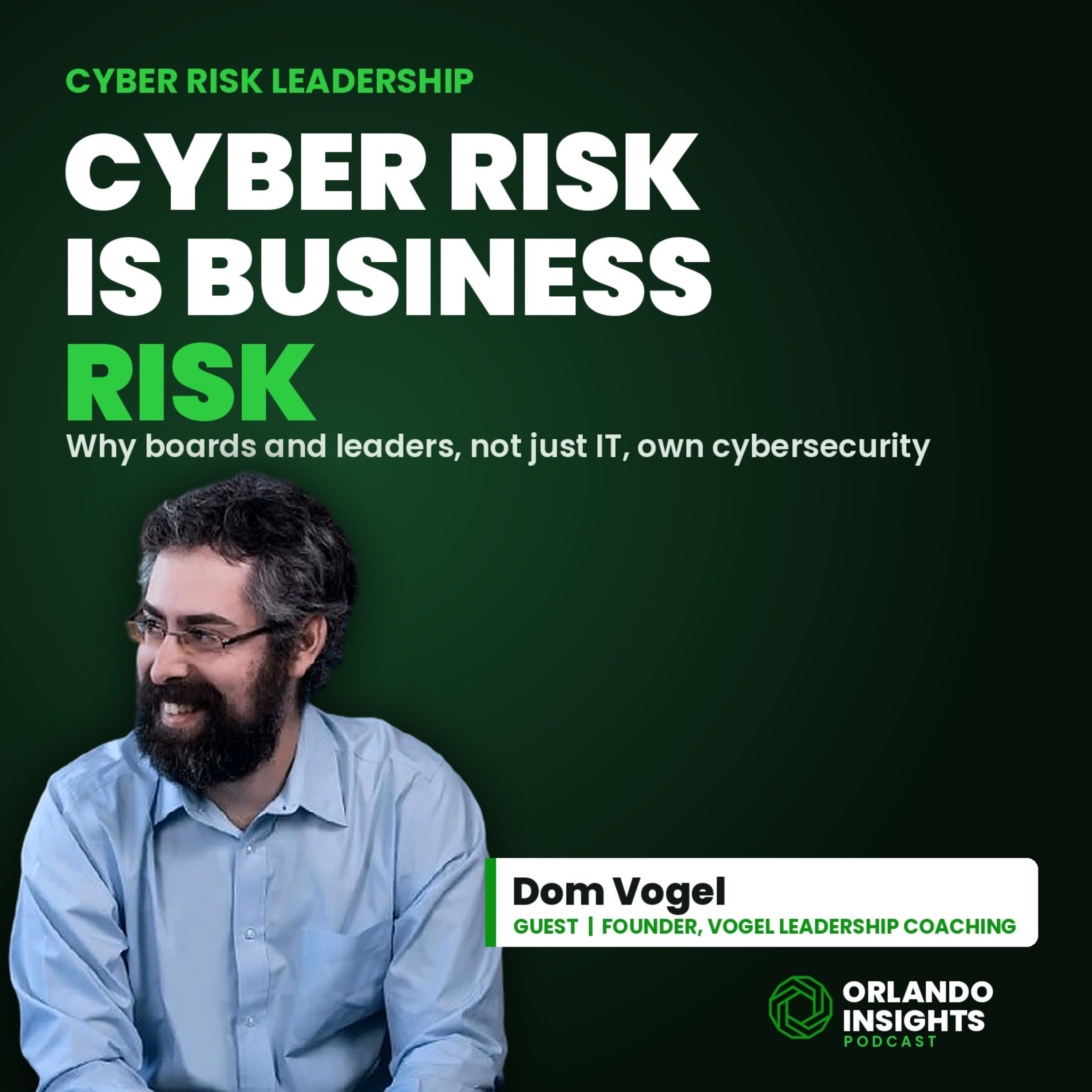
Why is cybersecurity a business and people problem, not only a technical one? Dom Vogel, founder of Vogel Leadership Coaching, tells host Erin Moody how to take cyber risk to the board and speak the language of business and risk.
Who it's for: Business owners, executives and security professionals who need to treat cyber risk as business risk.
In this episode you'll learn:
- Why cybersecurity is a people problem, not only a technical one
- How to take cyber risk to the board in the language of business and risk
- Lessons from a small business wire transfer fraud story
- The future of cybersecurity and AI-driven threats
- How to break into cybersecurity with technical and people skills
Dom covers leaving corporate to start his own business, kindness and culture at work, a small business fraud story, the future of AI-driven threats, and advice for breaking into cybersecurity.
Chapters
0:00 Welcome and introduction
1:54 Why he left corporate to start his own business
6:00 The assumption audit
10:01 Cybersecurity is a people problem
12:09 Taking cyber risk to the board
13:57 Speaking tech, business and risk
15:58 Kindness and workplace culture
18:00 Make the most of people while they are with you
22:08 Waiting for a cyber heart attack
23:57 A small business wire transfer fraud story
26:01 Reframing security as business risk
30:01 Encouraging dissent to get better ideas
32:04 The future of cybersecurity and AI-driven threats
36:13 Turning LinkedIn connections into real relationships
41:58 Breaking into cybersecurity: technical and people skills
43:57 Job search advice from the hiring side
48:12 Wrap-up
More episodes: https://orlandoinsightspodcast.com
Find Dom: https://vogelleadershipcoaching.com and Dominic Vogel on LinkedIn.
Guest: Dom Vogel, Founder, Vogel Leadership Coaching
Hosted by Erin Moody for Orlando Insight Group. Henry Clavo, Founder & CEO: https://www.linkedin.com/in/henryorlandoclavo/
The Orlando Insights Podcast is brought to you by Orlando Insight Group, data and AI advisory for CIOs and Chief Data Officers: AI Readiness Assessment, Data Governance & AI Foundations Sprint, and Fractional Chief Data & AI Officer. Book a free 30-minute AI readiness consult: https://calendar.app.google/xkJqUsFzrHAVkY4W7
https://orlandoinsightgroup.com
#Cybersecurity #CyberRisk #OrlandoInsightsPodcast
Transcribed automatically by PodView
My name is Erin Moody. I work with Orlando Insights Group and we are a technology consulting company. And what we really wanted to start doing is some podcasts and video interviews with some incredible people in the industry to teach our audience all about technology. So for our inaugural event, we have Dominic Vogel with us today. Dom is a globally recognized cybersecurity leader, keynote speaker, and leadership coach with over 15 years of experiences helping businesses build strong people-centered security cultures.
He is the founder of Vogel Leadership Coaching, and he blends technical expertise with emotional intelligence to guide organizations through today's evolving digital threats. He has awesome posts on LinkedIn. So if you are not following him already, definitely encourage you to do so to get a nice spark and start to your day. So welcome, Dom, to our first podcast. Erin, my friend, thank you so much for having me on here. And that's like the best intro I've ever heard of myself. So I'm going to have to steal that from you and use it.
Right. I will also turn it over to you afterwards.
Awesome. All right. So we can just jump in. So my first question kind of goes into your transition into entrepreneurship. So you began your career in corporate cybersecurity before you founded your own venture. So just curious, what motivated you to take that leap into entrepreneurship and what challenges did you face during that shift? I know you're not easing me into any easy questions. You know, it's I'm celebrating 10 years as an entrepreneur this year. It's been 10 years since I've left corporate, and I jokingly say that I don't think I can ever go back to corporate.
A, it's been too long, and B, I'm pretty sure I'm broken in terms of being able to work in that type of culture. But it wasn't so much a motivation as it was that, as it is, unfortunately, for a lot of people, working in an extremely toxic environment. I worked under an extremely toxic person. I ended up burning out. I didn't realize I was burning out until my wife said to me one day, I don't even recognize you anymore. You are, you know, you're always cynical. You're jaded. You're not you, you know, and that was an earth shattering moment for me, you know?
And I remember looking at when I was at work in my final days and I was, it was around the time where I'm not sure if you remember the Christian Bale Batman movies, you know, the trilogy. And the previous night I had watched, um, one of the movies and it was a line I always forget who said the line but the line stuck with me um and it motivated me to make the change it said either you die a hero you live long enough to see yourself become a villain you know and I remember looking around at my colleagues at at work and they were all what I refer to now as corporate gargoyles they they they they had no soul in terms of what the work meant nothing to them.
It was a paycheck, you know? Right. Oh, yeah. And I've always been someone who's been intrinsically motivated, right? That inner flame, right? Where something that motivates you. And I can feel that flickering. And I realized at that point, I was like, well, either I move now or that flicker is gone. I become a villain, you know, a corporate villain, so to speak. And I made the decision right then and there. So some small part I owe, batman slash christopher nolan christian bale uh the fact that they pushed me onto the path of being entrepreneur i resigned uh that that day when i had that enlightenment oh that day i said i said i'm done i'm not doing this anymore i went to um my car uh and i uh it was no two weeks notice or anything i was i was done and i laughed and i went to the car and i called my friend who was a recruiter and he'd been in my year for the longest time he said dom you could be getting way more as an independent contractor and this was 10 years ago and he said you could even get remote work which was not very common back then yeah and so i remember i called him in the parking lot of uh my former employer and i said um to him i said you know what if you're the hotshot that you said that you are you're gonna find me an opportunity because i i at the time i It was a single source of income for my family.
My daughter was four at the time. I said, I just quit. There's no money coming in. I need you to be the recruiter that you say that you are. And he said, give me 30 minutes. And true to form, he called me 30 minutes later. He said, I got someone on the line here. They want to give you a one-year contract, fully remote. And so that started my pull away from corporate. And as I used that first year of doing some remote work, I recognized where I wanted to where I thought I could have the greatest impact you know and I've gone through various reimaginations over my 10 years as an entrepreneur and you know that the first few years are very much just sort of contract taking a few contracts here and there then I started to put myself in a very uncomfortable space of hey you know what all I ever thought I could do was corporate cyber security but I end up learning how to do sales how to do marketing how to do branding, how to build relationships.
I pushed myself and I always assumed I couldn't do these things. And I went through this process where I call an audit assumption. I wrote down all these things that I believe about myself to be true and I actively challenged them. And that pushed me on a path to the, you know, eventually the person that you and my other friends over the past decade have met, particularly on LinkedIn, where I've tried to, like I said, very much focus on just being very relationship centric, people-centric. And sort of the current manifestation or current reimagination of where I am as an entrepreneur right now, it's brought me to an area where there's three areas of passion.
As an entrepreneur, I've now come to appreciate that you don't chase money, you chase passion. You chase what sets your soul on fire. If you do that, the money will come. And for me, those three things are cybersecurity. So I focus on small and mid-sized organizations, primarily B2B organizations that are really struggling with how do we deal with this? And this is at the executive level, board level, strategic level. And that's one area of my professional passions. The other one is being able to do coaching, right?
Focusing on essentially tech leaders who are very good with tech, but really struggle to lay out a strategy, communicate to the board, inspire their team. They really struggle with their people skills. I have organizations that bring me in to level up their tech leaders and truly make them leaders. and then the last piece for me is professional speaking speaking at tech events uh other events again giving an injection of humanity and technology and how they blend and linkedin is my social glue as you know so it's a very long-winded first answer and but i could give you i love how you kind of took us on the the trajectory because i think that there i think there are a lot of people that can probably resonate with working in corporate and maybe feeling like there's something else out there.
But also maybe being afraid to take that leap and thinking that they have to have it all figured out. And I think like you said, like you took time to kind of try a few different things. And I'm sure that led to insights and you kind of figured out, you know, what, what made you feel that passion, what lit you up versus what you didn't like. So that's the nice thing about being an entrepreneur is you, you don't have to do the things that you don't like. You can focus on what you're good at and where you bring value.
And I love that you're coaching the, um, the tech organizations too, because you're maybe helping some of those managers not be toxic. Like I believe most people want to be good people. Maybe they just don't have the skills. So that's really cool. You're like bringing it full circle. I love that. Thank you. Yes, yes. And you're right about toxicity. Some of it is unintended toxicity, right? Especially in groups like tech people where I'll just say traditionally they don't develop their people skills to the same extent they develop their technical skills.
They don't realize they're giving off this unintended toxicity, right? And so that's where, again, leadership and investing in them as people helps grow them as leaders, but more importantly, helps grow the team as well. And it's not just more tech. I'm a big believer in the tech space. More technology isn't the answer, right? You need to infuse it with the right amount of humanity. Exactly. Exactly. No, I love it. Thank you for that. So kind of leading into my next question with the human element in cybersecurity.
So you just mentioned it's not all about the tech. It's also human-centered. So could you maybe elaborate a little bit more on how organizations can address the human factor of the cybersecurity effectively and kind of avoid the missteps that I'm sure you've seen? you know what and i i'm a big believer and i'll sort of contrast what i'll say is sort of a standard security answer to that question and then what i believe is the more people oriented question or the answer to that question so a standard security person will give you the answer of oh we need security awareness training we need to make sure people are aware in terms of what not to click and click that type of thing um that's very tired very dated very my mind just very bad advice.
The fact that in this day and age, we're still creating systems that one person inadvertently clicking on something that they can bring that down. That's a really crappy system. We're not creating very resilient systems. So to me, when we're talking about people in cyber, it's not at the, I'll lack of a better term, user level. Where we need to talk about people is at the leadership level, right? This is with the people who own organizations or CEOs, CFOs, C-suite, board of directors, particularly within the small and mid-sized organizations.
Enterprise has moved with cyber risk and looking at it from a risk perspective. One of the things when I go talk with boards or executives in the small and mid-sized business space is I try really hard to call it cyber risk and not cyber security. Because cyber security, unfortunately, has this connotation that non-technical, non-IT business executives, when they hear cybersecurity, they automatically think, oh, that's something for the IT team to deal with. It's not. Maybe operationally, maybe how it's implemented, yes.
But fundamentally, it's a risk. And so to truly infuse the people part of cybersecurity, it's needing leadership to adopt it as a risk. Your personnel risk, operational risk, financial risk, there's all sorts of risks that organizations face. And they talk about it in the risk lens. We live in a very digitized age, right? Here we are on the opposite sides of the continent and we're doing a LinkedIn Live, right? Technology has come very, very, very far. But with that, we need to understand that there are risks with this.
It's not just a tech thing. It's very much intertwined, interwoven in business and such risk comes with that. So by elevating this outside of I say IT and elevating it more so into the board level at the executive level you need to have boards and executives and leaders talking about through a risk lens. That way, the IT people, the IT service providers, there's greater alignment there in terms of what's being done. Because what I see as one being the greatest gaps with, again, the people part is an IT company, IT service provider, our internal IT team for your average small midsize organization, they're getting very little guidance from the board or their executives.
So they're doing at best an ad hoc approach to cybersecurity. And then what you have is the law of assumptions kick in where IT assumes one thing, board executives assume another. And when a data breach happens or ransomware or some really bad security incident happens, board executives say, well, IT, I thought you were doing that. And IT is like, no, you never told us to do that. or this just happened to me a few days ago Aaron, I received a call from a prospect a CFO from an organization they said yeah we just got hit by ransomware we needed to have our data back up within 24 hours I said okay well what's your current set up?
They said well the IT team set it up for 72 hours I said okay well did you ever communicate that to the IT team? No. I said well they're just going off best practice right like you need to have these conversations otherwise there's no alignment right so back to why I do coaching I jokingly refer to it as cheap couples therapy a lot of organizations IT and lack of better term the business they're like couples that don't get along right or just they want they talk like you don't you don't listen to me right yeah that's where I come in and I can talk talk I talk tech I talk business and risk right so I think that to me that's bring this full circle now, the people part that we need to solve with cyber is that we need to get everyone talking on the same page and not just tech and business or risk and having that chasm.
Yeah, that makes a lot of sense. Just thinking to my corporate days as an HR business partner for our, yeah, I did cybersecurity and IT. And yeah, like that would be the issue. Like they wouldn't be able to communicate and it's almost like they needed um like an interpreter which is kind of like what yeah that's um that's what I was getting from you that's kind of what you are so and that is like the people in tech are so smart on what they do and then the leaders are smart and they know what they do but it's like you have to be able to talk to each other to make sure that everybody's on the same page and like you said protecting the company from risk so yes awesome Love it.
All right. Perfect. So for as far as leadership coaching, you can dive a little bit more into that. That's kind of your focus right now. So one of the things that you really talk about in your posts and that I get from your website and everything is that you're really working on developing or helping them develop qualities such as empathy and self-awareness. So why do you believe those qualities are so important for leaders, particularly in the tech industry? Yeah, that's a really great question, Aaron.
You know, and I'll answer it sort of in a backwards fashion in that I believe it's necessary for all levels of leadership. Right. We don't see enough leaders, regardless of if it's in tech or other sectors that are rooted in empathy, in kindness. And, you know, there's all sorts of analysis studies have shown. I just read an article the other day from Harvard Business Review that was talking about how kindness has such a positive impact on culture. So much of corporate America slash Canada, corporate world is rooted in very dated approaches in terms of leadership and structure.
right um and it's not rooted in empathy or kindness but again time and time just think about your own life if someone makes you feel appreciated and you know that's why i've seen my own growth on linkedin if you make people feel good they want they will give you more they will show up more you'll have easier conversations who wants to show up for someone who makes you feel like a pile of dog crap right so it it it's not just feel good stuff this is again to me it's rooted in science and it's rooted in real world benefits that organizations that have leaders that are structured to be able to are empowered to lead like i said through empathy through kindness through compassion that's how you get the best out of your people while they're with you right we live in an age where it's not like bygone eras where people stay with organizations for 20 30 40 years right both my parents were teachers they taught at the same school for 35 plus year right when I left corporate, they could not wrap their head around that.
Even when I job popped before I became an entrepreneur, they still couldn't conceive that. When I got my first corporate job, they were like, oh, great, this is a great place for you to work for the next 25 years. I was like, I'm not working here for 25 years. I don't know what the hell you're talking about. So I really believe that modern leadership, in order to get the best while your people are there, it's like shooting stars. You need to create an environment that allows you to capture just that shooting star brilliance and tools to do that are empathy, kindness, compassion, leading through levels of vulnerability.
That's how you're going to get your people to operate at their best while they're with you. We need to change this whole notion of, oh, we're going to try and hold them as long as we can. That's the wrong approach. Make the best out of them while they're with you, however long that ends up being. I'm a big believer in that. Why I focused on the tech space, I guess, is twofold. One is, I grew up in that space. For lack of a better term, whatever tech people, especially cybersecurity people are thinking, feeling, I've been there, and then some.
They're almost 20 years of being in the field. I know what they're feeling. So when I'm coming from a point of saying, here's how we're going to develop more empathetic communication, I can do so in a way that I know will better resonate with them compared to another coach who has never been in the field. IT people and tech people, I'm sure you can appreciate this, Aaron, they listen to their own more so than those who have never been in their footsteps.
So that's why I focused there. But the other reason, like I said, why I focused there is that I truly believe that the next quantum leap in technology isn't going to come from more technology or deeper levels in technology. Where I truly believe the next quantum leap is going to happen is when we do a better job of interlocking humanity with technology. And the only way that we do that is by really trying to level up the tech leaders out there, whether they're working for tech companies, whether they're part of an internal IT team, equipping them with the people skills necessary for that interlocking to happen.
There's going to be amazing harmonization there. And then and only then is we're going to truly unleash the full power of technology. Because to me, the thing I look at is, look how far we've evolved our technology, even over the past 100 years. But if you look at, I'll say, our collective humanity in terms of how far we've evolved as a society, I'd argue that we're not evolving at that same pace. technology is evolving at this pace. Our society has been at this and arguably now it's like that. Right.
How do we get that same accelerant curve? Because as a society and human race, we evolved at that same rate as technology. Think about all the amazing things we could accomplish then. Right. So that's why I've chosen to focus on that. I love it. That's so cool. And you're talking about that. I was just thinking about my own career and about the managers that I've had that were not even just managers, business leaders and the ones that have the highest performing teams, they weren't, like, I don't want people to think, like, if you have empathy, that means you're, like, a pushover manager.
Like, they're tough. Like, they have really high expectations, but there's still that empathy. Like you said, it, like, gives you the wants to, you know, make them be proud of you. For sure, for sure. I was actually having this conversation with one of my clients the other day, not to confuse kindness with niceness. Those are two very, very different things, right? Just giving an example, if someone gave a presentation, you want to give feedback to them. Niceness is saying, oh, hey, you did an awesome job, even though they were terrible.
Kindness is then rooting your feedback in the way that you say, hey, you know what? You have great energy. I've relived where you started. But slide three here, you kind of lost me. And here's, I think, how you can maybe do better next time. That's kindness. versus niceness. So never, ever confuse the two. Yeah, exactly. All right. Awesome. All right. So given your experience in cybersecurity, but also advising startups, small businesses, what have you seen as a common cybersecurity pitfall that these people encounter and how can they proactively mitigate them?
You know what? And I think you hit the perfect word there at the end there. The biggest issue I see is that organizations, particularly small and mid-sized organizations, do not act proactively enough. Most organizations at the SMB level I deal with, and this is true even now, even more so right now, where a lot of organizations are just sitting on money. People are scared to spend money. they they'll wait for what I call a digital or cyber heart attack. So data breach, ransomware, something, an adverse event happening.
Right. And then then they will spend. The problem with that is that when you wait for a reactive event, it's far more costly. And the risk of survival is much, much lower compared to if you were to deal with it beforehand. And just like in real world, an analogy I often give to prospects is, let's say you're on a one-way train to a heart attack. You can make the steps now and change your lifestyle now, and it's going to be far less costly and far lower risk. Or you can wait until that train pulls into the train station.
You have that massive coronary heart attack. Then it's going to be very expensive, very timely. It's going to take much longer. And again, the odds of you not surviving that go up. Right. So, again, it's framing it that way. That is the biggest misstep that I see with organizations is that they're far too reactive. And there's far too much what I refer to as 1995 level thinking with small and mid-sized organizations. And I still hear to this day, we're a small company. We don't have anything that anyone would want.
I was like, dude, that is so mid-90s. There was a time when that was true. And I will absolutely admit that even as little as, honestly, maybe even seven, eight years ago, you could get away with that argument. But over the past decade, in particular, even during COVID, where we saw it really accelerate, the focus and the global shift of cybercrime focusing on small and midsize organizations is every organization, even the smallest of companies, your one-person shop, right? You can get hit. One of my friends on LinkedIn, she reached out to me.
She's a one-person entrepreneurial shop. She got hit by a wire transfer fraud, and she lost $15,000. And for a one-person shop, she was like, that's a lot of money. I don't know if I can absorb that. Every organization is at risk. I jokingly say that unless you're selling tacos on the back of a Volvo and all-cash deals, you're a tech company. We all rely on tech. We all rely on data Very true And even if the biggest misconception is that we don have any sensitive data right Again that was true That may have been true in terms of what was important for criminals to steal right But in this day and age, and I said, every organization operates on data, right?
So even if your data and the systems you use, even if it can't be sold on the underground market, it has no monetary value. It has monetary value somewhere. It has monetary value with you, right? So if you as an organization, you lose access to your key data and you can't fulfill your organization's mission, guess what? That's costing you money. And cyber criminals know that, right? So even if there's no monetary value in the underground market, you're willing to pay to regain access to it. Otherwise, your organization ceases to exist.
So that, to me, to answer your question, is that the biggest missteps are that we're still clinging to misconceptions of the past. and that small and mid-sized organizations are not willing to have the conversations proactively that this is a risk. That this is a risk. It's not a tech issue. This isn't something that your IT team or IT guy or gal deals with. This is a business risk. That's the biggest gap. Yeah, that makes sense. I think you could put that in a lot of things where people are more reactive than proactive.
It's human nature, unfortunately, to wait. So I do, I absolutely do. Again, there's interesting psychology behind that as well. Human nature is often to wait until, you know, things are really bad. Then like, oh crap, maybe we should have done something about that. Right. So it is certainly human nature, but like I said, I think right now the best way of trying to get proactive around it is reframing it around risk unless it's a technical issue. Yeah. Yeah. Okay. Now that's super helpful. And hopefully, if there are any small businesses or medium-sized businesses on here, they're hearing that message and taking steps to be proactive.
Because we definitely want your companies to stick around and thrive. And it's not going to happen if you're falling victim to that. No, and I'll give a real quick, at least I think it's somewhat of a funny example. an organization I had been prospecting for probably close to nine months. I had a conversation with the CFO and I said, this is what it would cost to engage me now proactively. He said, yeah, I appreciate this, hold on to this, but we're not going to act on this. I said, just so you know, you can reach out anytime.
I said, if and when you reach out to me and it's when stuff has happened, there's digital blood on the wall, the price I gave you there, I'm going to 10X that. He's like, okay, sure. I got that. I was in Disney World with a family a few years ago, and I got a call, and I try not to answer my phone on holidays, but I recognized that it was that prospect. I'd been trying to get a hold of for nine months and picked it up, and I said, hey, what's going on? And he said, yeah, we just got hit with a significant security issue.
This is a big incident. We're going to need your help. I said, do you still have the proposal I gave you? He said, I do. I said did you write down that I was going to 10x that he said I did and I said okay I'm on vacation right now Disney World I said so if you want me to act on it now I'm going to 15x that if you can wait five days I will actually know when I come back he said I'll wait till you come back and then again they ended up being a long term client again I do appreciate he said you know what I was wrong he said this is something we should act on proactively.
He said, I didn't think that this was a big, big, I said, I, he said, I didn't think this was a risk. So, um, I hope that example illustrates, like I said, this is a risk. This isn't a tech issue. Yeah, no, that's a perfect example. And unfortunately they didn't listen.
I'll pay for the Disney vacation. Oh man. Uh, no, that, that's a great example. Thank you for, for sharing that. So jumping back into empathy, because that is something near to my heart, of course, and I know that it's important to you too. So we talked about the importance of empathy in leadership. How can tech organizations use empathy and leadership to impact team dynamics and project outcomes. So that ROI, like putting that, because that's very important to kind of say, you know, yeah, it's good to be nice, but how does it impact?
Yeah, it's such a good question. You know, and I work with a lot of my clients. I build out their security team from the ground up, you know, where I'm part of, you know, hiring out their first security analyst and building all the structure, you know. And the thing that I'm a firm believer in, And I do see it, again, from a team dynamic perspective. Again, think about from a human nature perspective. You can be more free with your ideas. It can be greater innovation when it's a safe psychological space.
You can only do that if you create a culture of empathy and trust and compassion. Are you going to bring up an idea that may go against the boss's idea if it's a culture of fear and intimidation and toxicity? No, you're going to keep your damn mouth shut, right? and or you're going to be looking for work elsewhere. You're not going to get truly innovative ideas, right? If you actively encourage dissent, if you actively encourage people to share their voice and say, you know what, as the boss, I'm saying this path, but you think otherwise, let's hear about it.
Let's have a discussion. That is, again, creating a culture of openness and empowerment. Right. So when we talk about, to me, empowerment and innovation are outcomes to open those gates, you need to use the keys of kindness and compassion and empathy. Those are the keys that open those gates. If you don't want a culture of innovation, empowerment, then, yeah, do the opposite of that. If you truly want an empowered culture, those are the keys that unlock that. Perfect. Yeah, I love it. And I think that just thinking back on my own career, and I've been really lucky, honestly, to have most of my leaders.
That's kind of the nice thing about working in HR. Typically, your leaders do have some good humans there. Yeah, but you would be surprised. I have definitely had a couple of instances where the person at the top was probably shouldn't have been working in HR, to be completely honest. And just like you said, if you have that level of fear and like, you're not going to speak up, like nobody's going to speak up. You're not going to get any ideas. People are going to collect their paycheck while they're actively looking for a new opportunity.
So it's a great example. And I think that the more leaders embrace that empathy and kindness, the more they're going to thrive and have an innovative organization. Cool. So I wanted to jump in. I know we're all seeing the technology is growing like crazy. We've got AI everywhere. It's changing and improving quicker than I think most of us imagined. So I wanted to get your thoughts on kind of what you think is the future of cybersecurity and if there are any emerging cybersecurity threats that you think that our business leaders should be aware of.
Yeah, great question, Aaron. You know, I'll put it this way, you know, in terms of at least the emerging threats or things that companies and executives need to be worried about. But far too many small, mid-sized organizations are not prepared for the threats of yesterday. There's a lot who are struggling to deal with the threats of today. The AI, generative AI, is essentially a supercharged fuel for these. And that if you are struggling to deal with, I guess, the threats of yesterday and today, your organization will cease to exist because of the threats of tomorrow.
Right. So one of my rallying cries is, you know, I try, let focus on dealing with the threats that you need to be dealing with now. I do hear a lot of organizations saying, Oh, well, what, what type of AI threat should we be worrying about? And the same token that these organizations aren't prepared to deal with the simplest of scabs or threats of today, you know? And I was, you know what, that's, that's like saying, if you're hogtied to a railway track and there's a train that's about to slice you in half and that's the threats of yesterday and today and the AI train is down the line, you can see the light in the distance.
By the time that train gets to you, the vultures will already pick you over, right? Sorry, that's a little gruesome, but that's the best analogy I can come up with. The AI threat train is very real, but like I said, in particular, small and midsize organizations need to start dealing with this as a risk and need to start dealing with it very quickly and proactively now. So by the time that AI threat train is closer, that they are in a much more robust, much more resilient state than they are today.
So I think that to me is the best way that I can sum up that. Because like I said, AI is making threats that much, the volume, the velocity, the veracity, that much higher, right? We are at a time that over at least the course of my 20 years in this field, I've never seen that level of threats in terms of how quickly they're evolving and changing in that speed. So we need to become much more dynamic because very much where we are right now is that cybercrime is heavily professionalized. It's not amateurs.
Yes, there are amateurs who do it, but it's heavily professionalized. And the sad state is that most small and mid-sized organizations take a very amateurish approach to cyber risk management. And just like in boxing, if you put up an amateur against a professional, that professional is going to do the KO 10 times out of 10. So that to me is where if we're talking about trends, what small and mid-sized organizations need to focus on. Nice. Yeah. And that makes sense. Fix what is the immediate threat now, like you said, what's happening in the moment and also what you've been ignoring for maybe the past five years.
It's like, let's. Time to pay down the debt. Time to pay the piper. Exactly. Yeah. You got to quit ignoring it. Or like you said, that when the new thing gets here, then it's too late. It's too far gone. So, yeah, I like that. All right. So jumping, I know I'm kind of bouncing around a little bit. That's okay. I'm loving this. This is amazing. So kind of going back to LinkedIn, I know that's how we got connected. I love your posts. And one of the things that you really focus on is relationships and building relationships.
So I wanted to ask you specifically, how do you turn this platform and other platforms into genuine connections versus just people who you are connected with? Like, how do you take it that next step further and create an authentic relationship? That's a really, really good question, Aaron. And you know six years ago I stopped treating LinkedIn as a sales tool I started treating it as what I refer to as my friendship finder And I a big believer that when you come from a place of being a giver in that you just try to give freely of your time, of your energy, and again, back to how you make people feel.
One of the things that over the past six years that I've tried to do with my content, uh a is with my comments is just to be a source of random joy or smile over the course of someone's day right there's still far too much negative energy on even on business platforms like linkedin right so that's why by doing that and coupling that with content that i hope brings some level of inspiration moments of kindness moments of compassion moments of like i said just smiles to those that follow me then i know i'm putting some good energy empowering energy into the universe and i'm a big believer that by doing that you put yourself on a path where you can build very meaningful friendships right and that even though again i'm not trying to lead or do this in the case of getting reciprocity human nature is when someone makes you feel good you want to spend more time with that person right so by engaging with people and showing up consistently day in day out commenting engaging supporting cheerleading um that then leads to dm conversations right that then leads to offline conversations right that then leads to opportunities that then leads to things that your mind cannot even begin to conceive i've been able to land paid speaking
opportunities gigs all sorts of things that my mind could not even begin to conceive all because of the energy and time i put into building meaningful authentic relationships and like said linkedin has been a tremendous generator for that and friendship finder for that right and that's like i said when you leave from a place of authenticity and genuineness and like i said not asking for things, but simply just trying to show up as a friend and I'll say operationalize friendship, make the time. Don't just show up to someone, make an ask and then leave.
Right. Always be having conversations, maybe catch up once a quarter, right? And I think of amazing human beings and friends like you are being able to form these meaningful friendships with where a couple of times a year, yo, we get to catch up on a video platform. And here we are now doing a linkedin live together right like it's to me it's but when you root things in authenticity and deeper meaning friendships flourish right and it attracts your tribe and it will repel the people who don't want who you don't want in in your universe anyway right so like i said to me it's about just trying to lead with authenticity with vulnerability um lean into being yourself and like i said the relationships will manifest and you just have to put in the energy to make sure that And like I said, I post about this a lot.
I'm a big believer in operation in the time to make sure that you're always building those and strengthening those relationships. Yeah. Awesome. I love it. We have a similar. That's why we're friends. Yeah. And I would say, too, like, I think LinkedIn is really nice for keeping up with people. Like, I don't I don't know if you have this, Dom, but I will get random messages from people that I worked with when I first started my career in recruiting. Like someone will say, oh, you used to be a college campus recruiter.
And every now and again, I'll get a message from someone and they won't be asking for anything. They'll just say, oh, I saw your post and I don't know if you remember me, blah, blah, blah. So I think that's really neat as far as a good thing with technology. because maybe I would have never heard from them again. If not from LinkedIn. Yeah, exactly. And again, back to that notion of how you make people feel. This happened to me last year. I landed a paid speaking engagement from someone heard me speak at a conference almost a decade ago.
And they asked me a question. And 10 years ago, I had a conversation with them and never thought anything of it. And last year, they reached out to me. And I said, I don't know if you remember me, but I asked the question and you, you spent like half an hour talking to me after your, your talk. I'm now a director of IT here. Very cool. We're looking to put on an event. I'd love you to be a paid speaker. I was like, that's amazing. I talked to this person once. Right. So, and now we, and now we have a, more of a friendship rather than just being an acquaintance.
Right. Because of that. So again, when you lead with empathy and you lead with kindness, that's like I said, that's what the world needs to see. Yeah. And that's a great example. Like you might be a nice person and have a conversation with someone. You're not necessarily going to get anything out of it right then. But who knows where what people are doing down the line and where they end up. So not that you're doing it to get something necessarily, but it has a way of working out that way. A lot of times I find.
So yeah, absolutely. Awesome. So my my last official question. Lots of unofficial questions.
So with with technology, we talked about the fact that some techie people may not have the best communication skills. They might have to learn that. So with people that might be thinking about getting into cybersecurity, because it is something that is top of mind. It's not going away. How do you think that they should balance their developing their technical skills and developing skills like communication and leadership? Yeah, I'm pretty sure I said this to every question, but great question, Aaron.
And I'll put this way. You're absolutely right. Cybersecurity is one of the hardest job markets to get into. Right. It's not going away with how deep we are in the digital world here. You now see even smaller organizations hiring for internal security analysts, organizations that would never have 10 years ago or five years ago would not have had an internal cybersecurity team. So we're seeing that really evolve and rapidly change. I'll put it this way. It's almost like the game Where's Waldo? Or the book, I should say, Where's Waldo?
So especially with all the tech layoffs that have been happening over the past 18 months, two years, there's a lot of people with a lot of technical skills on the market. Right. And this sounds paradoxical, especially to technical people, but if you want to stand out, it's not your tech skills that are going to make you stand out. That is basic table stakes. right what's going to make you stand out is your ability to communicate to articulate to write to be able to hold a conversation with someone who isn't technical um and again to illustrate with an example because i just like illustrating um i was going through a hiring process with a client of mine they're a small small um post-secondary institution in northern british columbia so in canada the province i live in and um fairly remote it's nowhere near a big city i live in in Vancouver, nowhere near Vancouver.
Okay. There was over 500, and it's a fairly small institution, 500 job applicants for a junior security analyst role, 500. Interesting. And as I read through the resumes, Ryan,
A, my eyes started to bleed because it looked like they were all using the same AI template to write the damn resume. Oh, wow. They're all using the same language. like oh i would relish the opportunity to you know work at this institution i said no one uses that word relish other than asking for it in the hot dog so um i get it it's they were all reading the same and then there was a handful that stood out you could tell the person was writing with a level of compassion and energy the words they were using it popped off the page some added a different color some structured it differently right and we and when we went through the interview process those that were able to carry a conversation and speak in a way that there was level of eloquence and confidence, right?
Rather than just a tech person that was just throwing a bunch of tech jargon at you, right? I thought this is so refreshing, right? So I tell people, whether it's recent graduates, people are looking to transfer into the field. To me, the areas of differentiation right now aren't the tech stuff, right? So like I said, one is showcase your ability to be beyond technical, right? The people skills, how you communicate and write is super important, right? The second one is network. It's the ability of, I think we've gone through this progression where it used to be what, you know, then there was a period of who you know.
Now we're in this period of who knows you, right? Tie that to personal branding, right? If you're not out there building relationship, building a brand, LinkedIn, at networking events, right? No one knows you, And guess what? You're going to get lost in the maze. Time and time again, I have so many people reaching out to me, Aaron, on LinkedIn saying, I've been applying for jobs for nine months, 10 months, a year. And again, I'm sorry that it's been taking that long. I can't imagine being out of work that long.
But when I ask them, what are you doing? Walk me through what you do in order to get work. They say, well, I'll apply to jobs. I'll spend five hours applying to jobs online. that's stupid that is a waste of time you are that is literally firing resumes into a black hole you will never land a job no wonder it's been 12 months if you take that same energy and time and put it into developing your people skills and developing meaningful relationships with people in the field you shorten that cycle immensely right so that's what people need to be focusing on if you want to get into this field.
Awesome. Great advice. So I'll kind of end it with asking you how people can get in touch with you. If they are a business owner, maybe they want help with cybersecurity, or if maybe they want some personal coaching. I appreciate that, Aaron. So So as Aaron said, I spend a lot of time on LinkedIn. So connect with me on LinkedIn, Dominic Vogel. I'm the only English-speaking Dominic Vogel, I think. There's a couple of Germans out there, but you can connect with me on LinkedIn. You can go to my website, Vogel, V-O-G-E-L, leadershipcoaching.com.
And again, you can connect with me there, drop me a line there. But those are the best two ways to reach out. If something resonated with you, if you need help, just reach out. I'm a big believer, like I said, if you just want to have a conversation, I'm not going to charge you. I love just having starting friendships. And if there's a way that I can help you, I will absolutely do so. I'm not Deloitte. I'm not going to send you a bill for 10K just for having a conversation. I love it. Well, thank you so much for your time.
Definitely appreciate you taking an hour out of your day to give us some insights. That is definitely our goal with doing this. we're planning on talking to people once a month or so. So if you are a business owner, you want to talk about something to do with cybersecurity, AI, anything technology related, send me a message on LinkedIn. I'd love to get more information. And if there are any topics that you guys are interested in, definitely let me know. And I will do my best to find an expert to talk about them.
And hopefully we can have Dom back on the show. We want to do it. long term. So maybe down the line, we can get your insights. I'll come back anytime, anytime, Erin. Time spent with you, my friend, is time well spent. So I will come back anytime, my friend. I thoroughly enjoyed spending time with you today and your audience. It was amazing. Thank you. Awesome. All right. Thank you so much and have a great day.
you
 Apple Podcasts
 Castbox
 Castro
 Goodpods
 Moon FM
 Overcast
 Pocket Casts
 Podbean
 Podcast Addict
 Podcast Republic
 Spotify