Building Real AI Systems: Why Context Engineering is the Missing Piece in Digital Transformation
The AI Adoption Crisis Nobody Talks About
Let’s be honest: the AI hype train is running at full speed. Every week, there’s a new breakthrough in large language models, another company announcing their “AI-first strategy,” and countless startups promising to revolutionize your industry with machine learning. Yet somehow, most enterprise AI projects still fail to deliver meaningful business value.
Why is that?
The problem isn’t the AI itself. Models like GPT-4 and other advanced LLMs are genuinely impressive. The issue is that there’s a massive gap between having access to powerful AI technology and actually building systems that work in the real world. That gap is where most organizations get stuck—and where context engineering comes in.
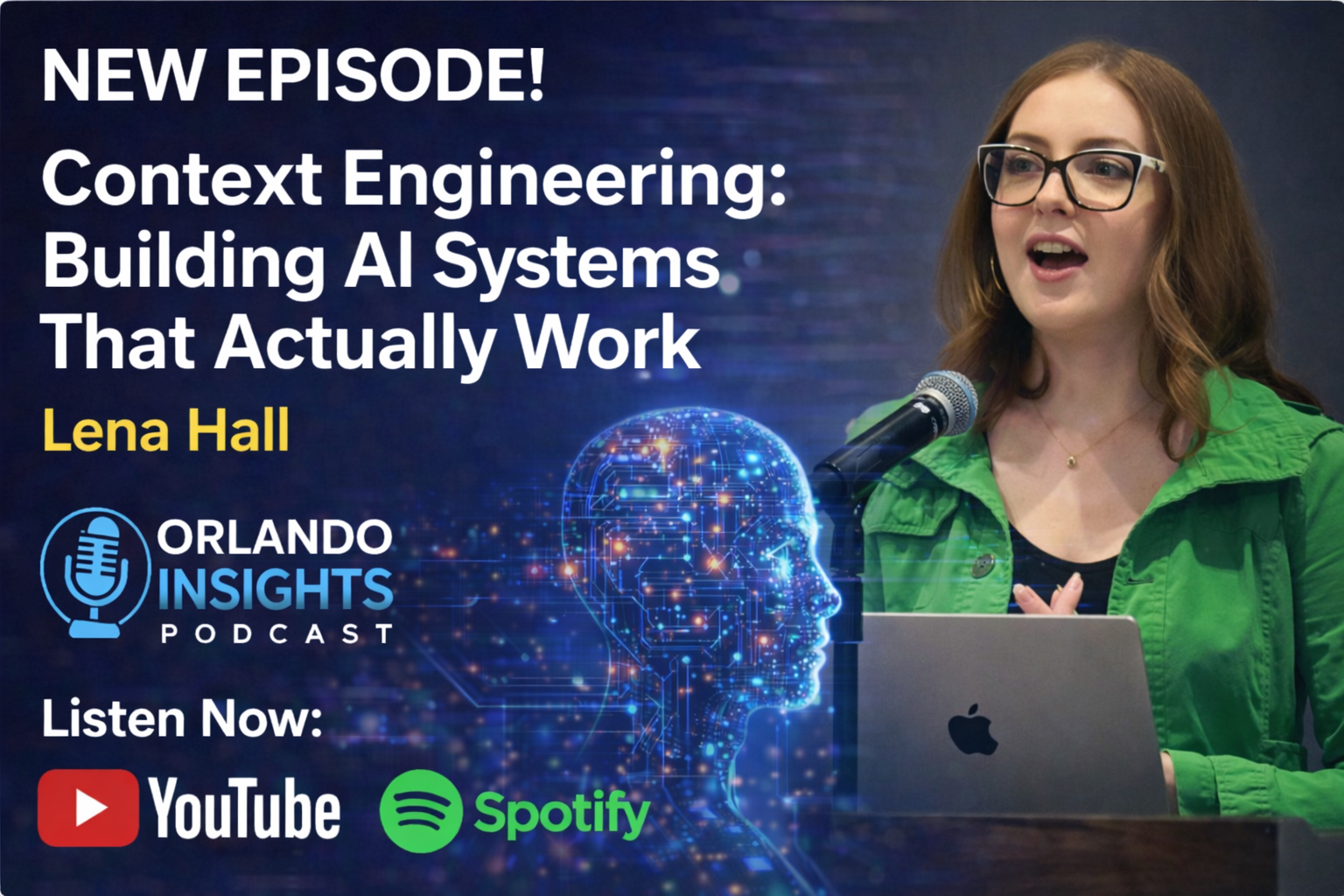
In a recent episode of the Orlando Insights Podcast, Founder and CEO Lena Hall broke down exactly why so many AI adoption efforts fall flat, and more importantly, how to structure your organization to succeed where others fail. With over 15 years of experience in data, AI, and pragmatic architecture, Lena has seen firsthand what separates companies that turn AI into competitive advantages from those that end up with expensive chatbots and abandoned pilot projects.
What Is Context Engineering?
At its core, context engineering is the critical missing layer between raw AI capabilities and transformative business outcomes. It’s the practice of strategically structuring how you feed information to AI systems, how you frame problems, and how you integrate AI outputs into your actual business processes.
Think of it this way: a large language model is like having access to an incredibly smart consultant who knows a lot about a lot of things, but doesn’t know anything specific about your business. Context engineering is how you make that consultant actually useful to your organization.
This means:
- Understanding your data landscape - What information does your AI system actually need to make good decisions?
- Designing information flows - How will data move through your organization to feed your AI systems?
- Creating feedback loops - How will you capture outcomes and continuously improve your models?
- Building organizational alignment - How will different teams work together to support AI initiatives?
Without context engineering, you end up with AI systems that technically work but don’t solve real problems. You get impressive demos that don’t translate to production. You get models trained on data that’s either incomplete or irrelevant to what you actually need.
Why Most AI Adoption Fails
According to Lena, the failure points typically fall into a few categories:
1. The Hype-Reality Gap
Organizations often adopt AI because it’s trendy, not because they have a specific problem they need to solve. This leads to solutions in search of problems, rather than problems driving innovation. When you start with “How can we use AI?” instead of “What business challenge are we trying to solve?”, you’re already heading for trouble.
2. Lack of Data Readiness
Many companies discover too late that their data isn’t actually ready for machine learning. It’s siloed across systems, inconsistently formatted, or missing critical context. You can’t build meaningful AI systems on a weak data foundation—and that foundation takes time and investment to build properly.
3. Organizational Structure Misalignment
Here’s something that doesn’t get enough attention: AI success is an organizational problem as much as it’s a technical problem. If your data scientists are isolated from your business teams, if your engineers don’t understand the business context, if your leadership doesn’t grasp what AI can and can’t do, you’re setting yourself up for failure.
4. Missing the Integration Layer
Even when companies build impressive models, they often fail to integrate them into actual workflows. The model sits in a notebook. The insights never make it to decision-makers. The system never actually changes how work gets done.
This is where context engineering becomes essential.
Structuring Your Organization for AI Success
So what does an organization that gets AI right actually look like?
According to Lena’s insights, successful AI organizations share some common characteristics:
Clear Business Alignment
Every AI initiative starts with a specific business outcome. Not “build an AI system,” but “reduce customer churn by 15%” or “decrease claims processing time by 40%.” This clarity drives everything that follows.
Cross-Functional Teams
Your data scientists need to work closely with domain experts, business analysts, and operations teams. The context that makes AI useful comes from understanding the business deeply, not just having great ML skills.
Pragmatic Architecture
Rather than trying to build the perfect system, successful organizations build systems that work well enough to deliver value, then iterate. They understand that 80% of the value often comes from relatively straightforward implementations.
Continuous Learning Loops
The best AI systems get better over time because they’re designed to capture feedback, measure outcomes, and improve. This requires building measurement and iteration into your processes from day one.
Data as Infrastructure
Finally, organizations that succeed with AI treat data as critical infrastructure. They invest in data governance, quality, and accessibility. They understand that good data is the foundation everything else is built on.
The Practical Path Forward
If you’re leading a team or organization thinking about digital transformation and AI adoption, here’s the takeaway: don’t get seduced by the hype. Instead, focus on pragmatism.
Start by asking: What specific business problems are we trying to solve? What data do we actually have access to? What organizational changes do we need to make to turn AI insights into action? How will we measure success?
Then, build your context engineering strategy around those answers. Invest in the foundational work—data infrastructure, team structure, clear metrics. This isn’t as exciting as announcing an AI initiative, but it’s what actually drives results.
The companies winning with AI right now aren’t necessarily the ones with the fanciest models. They’re the ones who’ve done the hard work of context engineering—aligning their organization, their data, and their strategy around specific business outcomes.
Ready to Build Real AI Systems?
If you want to dive deeper into context engineering, digital transformation strategy, and how to structure your organization for AI success, you need to listen to the full episode with Lena Hall on the Orlando Insights Podcast.
She shares concrete examples of where organizations go wrong, practical frameworks for thinking about AI adoption, and specific strategies you can start implementing right away. Whether you’re a technical leader, architect, or decision-maker responsible for digital transformation, this conversation will change how you think about AI in your organization.
Listen to the full episode now and start building AI systems that actually deliver business impact.
The Orlando Insights Podcast features conversations with cybersecurity experts and thought leaders exploring tech trends, innovation, and the practical application of emerging technologies. Stay ahead in your field with insights on digital transformation and the technologies shaping the future.